ABOUT
Information
Sports equipment stores sell the gear people use to participate in sports, but School Of Stores is also interested in how those retailers can help create more participation, stronger local sports communities, and new demand for the products and services surrounding play.
ART GALLERY
The Latest Visuals
BLOG CATEGORY
Sports Equipment Stores
Blog entries associated with Sports Equipment Stores appear here automatically.
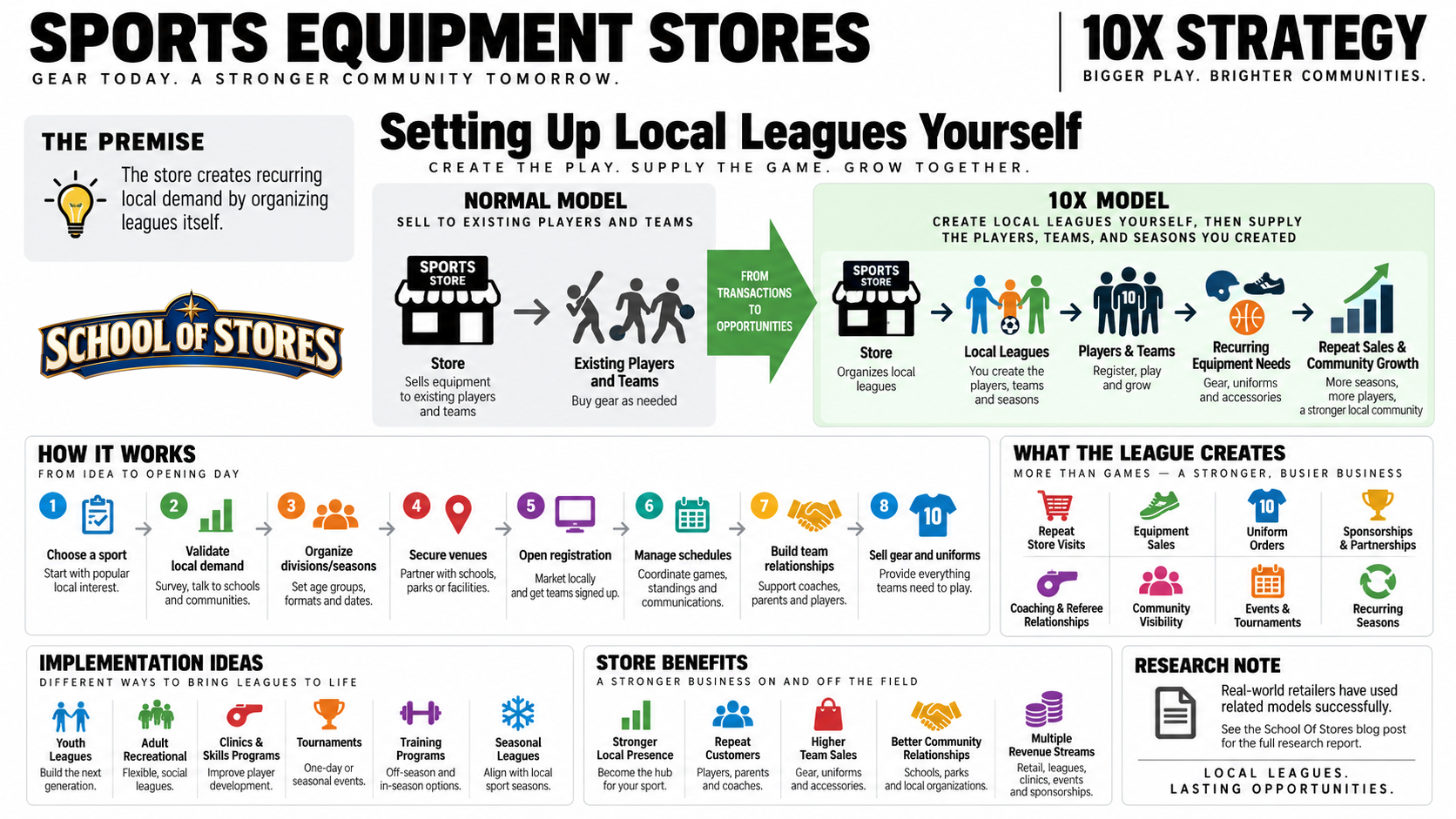
10X Strategy: Setting Up Local Leagues Yourself
September 18, 2026
EMAIL OUTREACH
Reaching Out To Sports Equipment Stores
School Of Stores can share its developing research and strategies with independent and chain sports equipment retailers, learn which local-sports programs they already support, and ask operators, coaches, suppliers, and service providers where stores could play a larger role in creating participation and strengthening the surrounding sports ecosystem.
10X STRATEGY
Setting Up Local Leagues Yourself
Instead of only waiting for existing teams and leagues to create customers, a sports equipment store could organize local leagues itself—helping create recurring participation, team relationships, equipment needs, repeat seasons, and community activity that feed back into the store.
10X STRATEGY
Setting Up Local Leagues Yourself
Research: School Of Stores research found real sporting-goods retailers already operating or supporting recurring leagues, training programs, and events, including a Play It Again Sports location in Wichita that handles baseball operations for a local sports complex; the research supports the operating concept but does not establish a measured literal 10X financial result.
MORE INFORMATION
Number Of Sports Equipment Stores
The U.S. Census Bureau counted 20,373 employer establishments in the Sporting goods stores industry in 2023, which is a useful national benchmark for established employer locations rather than a complete live census of every current sporting-goods seller, nonemployer business, or online operation.[1]
MORE INFORMATION
Number Of Sports Equipment Stores
Footnotes
- U.S. Census Bureau. 2023 County Business Patterns — Sporting goods stores (NAICS 45111). 2023 data; accessed September 18, 2026. Reports 20,373 U.S. employer establishments in the Sporting goods stores industry. This is a dated employer-establishment benchmark, not a live count of every sporting-goods seller, nonemployer business, or online operation.
MORE INFORMATION
Trade Associations & Industry Events
Sports equipment retailers sit inside a mature trade ecosystem. The National Sporting Goods Association directly serves retailers and team dealers, while the Sports & Fitness Industry Association connects retailers with hundreds of brands, manufacturers, governing bodies, leagues, technology companies, and other industry participants.[2][3]
MORE INFORMATION
Trade Associations & Industry Events
Footnotes
- National Sporting Goods Association. NSGA — The Premier Sporting Goods Industry Trade Association. Accessed September 18, 2026. NSGA describes retailers and team dealers as central to its mission and connects members with industry suppliers, research, advocacy, and events.
- National Sporting Goods Association. Membership Overview. Accessed September 18, 2026. Describes retailer/team-dealer networking with vendors, business resources, industry research, service-provider relationships, and the NSGA Leadership Conference.
- Sports & Fitness Industry Association. About SFIA. Accessed September 18, 2026. SFIA represents more than 700 sporting-goods and fitness brands, manufacturers, retailers, governing bodies, and sports leagues across more than 3,000 business locations, plants, and distribution centers.
- Sports & Fitness Industry Association. Become a SFIA Member. Accessed September 18, 2026. Shows an industry ecosystem spanning apparel and footwear, fitness, golf, physical education, team sports, retailers, small businesses, technology, manufacturers, distributors, and professional service firms.
MORE INFORMATION
Vendors & Supporting Services
A sports equipment store can depend on a wide network of manufacturers, distributors, brands, team dealers, uniform and decoration services, repair specialists, POS and e-commerce technology, logistics, insurance, payments, marketing, professional services, and sport-specific fitting or maintenance expertise.[5][7]
MORE INFORMATION
Vendors & Supporting Services
Footnotes
- Sports & Fitness Industry Association. Become a SFIA Member. Accessed September 18, 2026. Shows an industry ecosystem spanning apparel and footwear, fitness, golf, physical education, team sports, retailers, small businesses, technology, manufacturers, distributors, and professional service firms.
MORE INFORMATION
Starting A Sports Equipment Store
Starting a sports equipment store means choosing a clear product and customer focus, securing reliable supplier relationships, planning inventory and working capital, deciding between physical and online selling, building fitting or service expertise where needed, and creating reasons for athletes, families, coaches, teams, and clubs to return.
MORE INFORMATION
Starting A Sports Equipment Store
MORE INFORMATION
Websites & Apps For Sports Equipment Stores
Sports-equipment websites and apps can connect ecommerce with the playing life around the merchandise: inventory, pickup, loyalty, lists, in-store product scanning, fitting or service appointments, league information, and local events can reinforce one another. DICK'S Sporting Goods currently combines shopping, loyalty, lists, app offers, and an in-store scanning mode.[8]
MORE INFORMATION
Websites & Apps For Sports Equipment Stores
Footnotes
- DICK'S Sporting Goods. Mobile App. Accessed September 22, 2026. Current sporting-goods example combining loyalty, lists, app offers, shopping, and an in-store item-scanning mode.
MORE INFORMATION
Rewards & Equity Crowdfunds For Sports Equipment Stores
Reward-based crowdfunding can test support for a new local league, demo/training area, equipment-library program, youth clinic series, or a new store-designed sporting product, while an equity crowdfunding offering would involve selling securities rather than perks.[9][10]
MORE INFORMATION
Rewards & Equity Crowdfunds For Sports Equipment Stores
Footnotes
- Kickstarter. How Crowdfunding Works: A Guide for Creators. September 2026. General reference for reward-based crowdfunding: backers can receive rewards, while Kickstarter does not provide equity or ownership to backers.
- U.S. Securities and Exchange Commission. Regulation Crowdfunding. Accessed September 22, 2026. Current federal overview: eligible issuers may raise up to $5 million in a 12-month period through an SEC-registered broker-dealer or funding portal, subject to disclosure and other requirements.
MORE INFORMATION
Supply Chain Opportunities
The sporting-goods supply chain creates entry points far beyond owning the store: designing or manufacturing equipment, supplying components, distributing products, decorating team apparel, repairing gear, building retail technology, operating logistics, producing training products, or providing specialized services to retailers, teams, leagues, and athletes.[3][7]
MORE INFORMATION
Supply Chain Opportunities
Footnotes
- Sports & Fitness Industry Association. About SFIA. Accessed September 18, 2026. SFIA represents more than 700 sporting-goods and fitness brands, manufacturers, retailers, governing bodies, and sports leagues across more than 3,000 business locations, plants, and distribution centers.
- Sports & Fitness Industry Association. Become a SFIA Member. Accessed September 18, 2026. Shows an industry ecosystem spanning apparel and footwear, fitness, golf, physical education, team sports, retailers, small businesses, technology, manufacturers, distributors, and professional service firms.
MORE INFORMATION
Opportunities For Improvement
Sports equipment stores can look for improvements in fitting and product expertise, team ordering, used-equipment trade-ins, repair and maintenance, inventory visibility, online/local integration, affordability, beginner access, customer education, and programs that create more opportunities for people to participate in sports.
MORE INFORMATION
Opportunities For Improvement
Footnotes
- Sports & Fitness Industry Association. About SFIA. Accessed September 18, 2026. SFIA represents more than 700 sporting-goods and fitness brands, manufacturers, retailers, governing bodies, and sports leagues across more than 3,000 business locations, plants, and distribution centers.
- Sports & Fitness Industry Association. 2026 Manufacturers’ Sales by Category Report announcement. March 31, 2026. Reports approximately $130 billion in 2025 U.S. sporting-goods-industry wholesale sales across equipment, athletic footwear, sports apparel, and licensed merchandise.
MORE INFORMATION
History Of Sports Equipment Stores
The modern sporting-goods retail ecosystem developed alongside organized sports, branded equipment manufacturing, team dealers, and national trade associations; SFIA traces its manufacturing-side predecessor to 1906, while sporting-goods dealers organized nationally in 1929 and became the National Sporting Goods Association in 1936.[3][6]
MORE INFORMATION
History Of Sports Equipment Stores
Footnotes
- Sports & Fitness Industry Association. About SFIA. Accessed September 18, 2026. SFIA represents more than 700 sporting-goods and fitness brands, manufacturers, retailers, governing bodies, and sports leagues across more than 3,000 business locations, plants, and distribution centers.
- National Sporting Goods Association. Our History. Accessed September 18, 2026. Documents the formation of the Sporting Goods Distributors Association in 1929 and its later consolidation and renaming as the National Sporting Goods Association in 1936.
ART ARCHIVE
Visual Records

FOOTNOTES
Sources
- U.S. Census Bureau. 2023 County Business Patterns — Sporting goods stores (NAICS 45111). 2023 data; accessed September 18, 2026. Reports 20,373 U.S. employer establishments in the Sporting goods stores industry. This is a dated employer-establishment benchmark, not a live count of every sporting-goods seller, nonemployer business, or online operation.
- National Sporting Goods Association. NSGA — The Premier Sporting Goods Industry Trade Association. Accessed September 18, 2026. NSGA describes retailers and team dealers as central to its mission and connects members with industry suppliers, research, advocacy, and events.
- Sports & Fitness Industry Association. About SFIA. Accessed September 18, 2026. SFIA represents more than 700 sporting-goods and fitness brands, manufacturers, retailers, governing bodies, and sports leagues across more than 3,000 business locations, plants, and distribution centers.
- Sports & Fitness Industry Association. 2026 Manufacturers’ Sales by Category Report announcement. March 31, 2026. Reports approximately $130 billion in 2025 U.S. sporting-goods-industry wholesale sales across equipment, athletic footwear, sports apparel, and licensed merchandise.
- National Sporting Goods Association. Membership Overview. Accessed September 18, 2026. Describes retailer/team-dealer networking with vendors, business resources, industry research, service-provider relationships, and the NSGA Leadership Conference.
- National Sporting Goods Association. Our History. Accessed September 18, 2026. Documents the formation of the Sporting Goods Distributors Association in 1929 and its later consolidation and renaming as the National Sporting Goods Association in 1936.
- Sports & Fitness Industry Association. Become a SFIA Member. Accessed September 18, 2026. Shows an industry ecosystem spanning apparel and footwear, fitness, golf, physical education, team sports, retailers, small businesses, technology, manufacturers, distributors, and professional service firms.
- DICK'S Sporting Goods. Mobile App. Accessed September 22, 2026. Current sporting-goods example combining loyalty, lists, app offers, shopping, and an in-store item-scanning mode.
- Kickstarter. How Crowdfunding Works: A Guide for Creators. September 2026. General reference for reward-based crowdfunding: backers can receive rewards, while Kickstarter does not provide equity or ownership to backers.
- U.S. Securities and Exchange Commission. Regulation Crowdfunding. Accessed September 22, 2026. Current federal overview: eligible issuers may raise up to $5 million in a 12-month period through an SEC-registered broker-dealer or funding portal, subject to disclosure and other requirements.