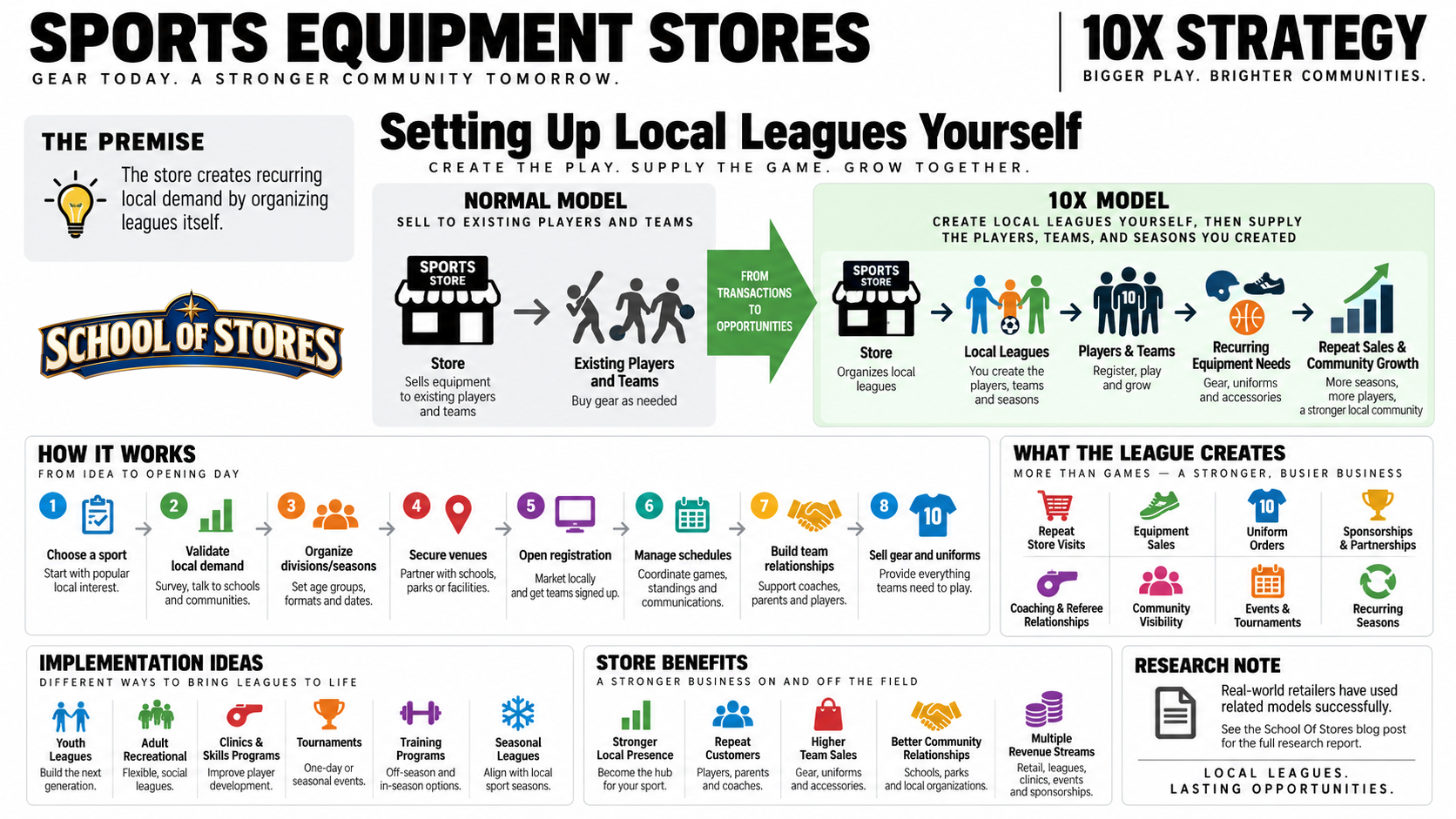
A sports equipment store does not have to limit itself to supplying demand that somebody else creates. A store could set up local leagues itself, helping create recurring participation, team relationships, equipment needs, repeat seasons, and community activity—and School Of Stores is exploring whether that kind of demand creation could become a 10X Strategy for the retailer.
Research Report
The question behind this research was deliberately narrower than asking whether sporting-goods stores sponsor local sports. Sponsorship is common. The more interesting question for School Of Stores is whether a retailer can move upstream and become one of the organizations that actually creates, administers, or repeatedly facilitates organized participation. If that happens, the store is no longer only waiting at the end of the demand chain. It is helping build the chain.
The Closest Match: Play It Again Sports Wichita
The strongest example located in this research is Play It Again Sports in Wichita, Kansas. The store’s own About page says the Wichita business hosts several tournaments and leagues during the fall, spring, and summer through Southwest Boys Club and Park City baseball/softball fields. This is important because the wording describes the retailer as a host of recurring competitive activity, not merely a company whose logo appears on somebody else’s league.
The relationship becomes even clearer at Genesis Sports Complex. The complex’s Youth Baseball League page states that Play It Again Sports handles all baseball operations at Genesis Sports Complex. For the 2026 season, players and teams register through the Play It Again Sports location, and the same page explains team registration, individual-player procedures, payment, scheduling, league championships, safety expectations, and other league administration. In other words, the retailer is functioning as part of the operating infrastructure of organized local baseball.
That matters to the 10X Strategy concept because league administration is directly adjacent to what the store already sells. The Wichita location sells new and used sports equipment, but it also operates batting cages. Its services page describes a free umpire school connected to Genesis Sports Complex and Southwest Boys Club, custom uniforms and fan gear, glove steaming and relacing, and other sports services. Its coach programs include team fan stores, rebates, discounts tied to team fittings, uniforms, special orders, balls, catcher’s packages, bags, helmets, and training aids.
These activities create a much more integrated business relationship than a normal one-time retail transaction. A coach can interact with the same business for league participation, uniforms, equipment, team fittings, fundraising, special orders, and support services. A player can interact with it for registration, used gear, cleats, batting-cage time, equipment fitting, and future replacements. The store is positioned around repeated moments in the customer’s sports life.
What The Wichita Example Demonstrates
The Wichita case demonstrates that the basic School Of Stores premise is operationally possible: a sporting-goods retailer can participate directly in recurring organized sport rather than remaining only a seller to people who happen to play. It also demonstrates that the league and retail sides can connect naturally through services that participants genuinely need.
It does not demonstrate that every sporting-goods store should run leagues, that the strategy automatically improves profitability, or that this specific Wichita operation produced a tenfold financial improvement. Public sources reviewed for this report do not disclose a before-and-after income statement isolating the league strategy. School Of Stores therefore treats “10X” as the strategic hypothesis: if a retailer can create substantially more participation and own more of the relationship surrounding participation, the upside could be much larger than ordinary promotional tactics. The literal multiplier still has to be measured.
A Smaller Example: Store-Connected Disc Golf Leagues
Disc golf provides another useful example of retailers connecting themselves to recurring play. Professional Disc Golf Association records show a series of leagues carrying the Play It Again Sports Asheville name. The Sandhill Sunday League — Sponsored by Play It Again Sports Asheville, which ran from December 2023 into February 2024, recorded 74 players. PDGA schedules show additional Play It Again Sports Asheville league series during 2024.
This is weaker evidence for the exact “set up the league yourself” proposition because the public PDGA pages describe the store as a sponsor and identify separate league directors. It is still useful evidence for the broader mechanism: a sports retailer can repeatedly attach its business to organized local participation rather than limiting community involvement to occasional advertising.
The Specialty-Running Model
Specialty running stores show an even more developed version of the participation-and-retail relationship. The sport is different because runners do not need a conventional team league to participate, but the business principle is closely related: the retailer creates structured reasons for customers to train, gather, return, and buy the products that support continued participation.
Charm City Run describes itself as a seven-location running and walking specialty company that also produces more than 100 endurance events annually. Its training program says a marathon group that began with about five people grew into training several hundred people per season. Training participants receive benefits that include a store discount and discounts on Charm City Run races. This is a clear example of a retailer building an activity ecosystem in which training, events, community, and retail reinforce one another.
Fleet Feet operates more than 280 stores and combines footwear/apparel retail with training programs and running groups. Fleet Feet describes those programs as part of its community model, and individual locations run paid multiweek training groups, free community runs, race-preparation programs, and other organized experiences. Its franchising materials describe stores as community hubs and specifically identify events, group runs, and training programs as experiences that help customers get moving and connected.
A particularly revealing detail appears in Fleet Feet program pages: training participants can receive gear guidance, sponsor-supported programming, and in some programs store-related perks or discounts. The retailer is not treating community programming as separate from commerce. It is creating a cycle in which participation creates legitimate product needs and the store’s product expertise supports participation.
From Sponsorship To Demand Creation
Most sports retailers already understand sponsorship. A store might sponsor a youth team, donate prizes, buy a banner at a field, give coaches a discount, or support a tournament. Those activities can be valuable, but they still depend on another organization to create the underlying participation.
The 10X Strategy asks what changes when the retailer takes responsibility for creating some of that participation. A store that organizes a league can decide which underserved formats to offer, when seasons run, how beginners enter, whether equipment can be bundled or loaned, how teams are formed, and how communication with participants continues between seasons. It can learn directly why players stop participating, what coaches struggle to obtain, what equipment fails, which age groups are underserved, and what facilities are missing.
That information is itself valuable. The retailer gains a feedback system that a normal store may never have. Instead of discovering customer needs only at the register, it sees the needs while people are actually trying to play.
The Potential Revenue And Relationship Loops
A local league can create several different loops around the store. Registration creates an initial relationship. Team formation creates uniform and equipment needs. Practices and games create replacement needs. Coaches may need balls, cones, bags, first-aid supplies, scorekeeping materials, training equipment, and special orders. Players grow, change positions, wear out equipment, or decide to participate in another season. Families may trade in used gear. Sponsors may need apparel or branded materials. Tournaments create additional traffic and event needs.
None of those purchases should be assumed or forced. A poorly designed league that exists mainly to compel retail purchases could damage trust. The stronger version of the strategy is to make the store genuinely useful at each step: simplify fittings, offer sensible bundles, stock what the league actually uses, provide used-equipment options, make repairs convenient, coordinate team orders, and help coaches solve recurring problems.
Over multiple seasons, the store could also accumulate relationships with officials, trainers, photographers, facility operators, food vendors, trophy suppliers, uniform decorators, schools, municipalities, clubs, and sponsors. That creates the broader business ecosystem School Of Stores is interested in. The retailer may become a connector among many businesses rather than only a reseller of sporting goods.
Why This Could Be Larger Than A Marketing Program
The most significant potential difference is that marketing attempts to capture a larger share of existing demand, while league creation can increase the amount of local participation that exists. If ten additional teams exist because the store helped organize them, those teams represent people who may not have been customers at all without the program. If a beginner league reduces the friction of finding a team, it may create new athletes. If an adult league gives former players a reason to return to a sport, it creates another population of participants.
This is why School Of Stores is labeling the idea a 10X Strategy rather than simply a promotional idea. The ambition is not “sell a few more gloves because the store sponsored a team.” The ambition is to change the store’s position in the local sports system—from a business that waits for participants to a business that helps produce participation.
What A Store Would Need To Learn
The strategy also adds substantial difficulty. Retail expertise does not automatically create league-management expertise. A store considering the idea would need to understand facility access, scheduling, registration technology, insurance, participant safety, waivers, local permits, governing-body rules, background checks where appropriate, coach and official recruitment, conflict resolution, weather policies, refunds, financial controls, and emergency procedures.
The store would also need to decide what should remain in-house and what should be handled by partners. A facility operator may be better at field maintenance. An established officials association may be better at assigning referees. A league-management software provider may be better than a custom spreadsheet. A local attorney and insurance professional should address the legal and risk-management structure. A strong 10X Strategy does not mean doing every task personally; it means assembling and controlling a system that produces a much larger outcome.
Possible Ways To Start Small
A retailer does not need to begin with a citywide youth league. It could test the concept with a four-team adult league, a short offseason season, a beginner clinic that leads into organized games, a recurring disc-golf league, a store-run running group, a weekend tournament series, or a partnership in which the store handles registration and team services while an experienced sports organization handles competition.
Those smaller pilots can answer the questions that matter before major investment: Will people register? Can the store communicate reliably? Are facilities available? Do coaches and officials want to participate? What does each participant cost to serve? Does the program generate repeat customers or only administrative burden? Which store services become more valuable because the league exists?
How School Of Stores Would Evaluate The 10X Claim
Calling something a 10X Strategy should eventually require measurement. A participating retailer could establish a baseline before launching the program and then track league registrations, unique households, first-time store customers, repeat purchase rates, team sales, uniform sales, equipment rentals or trade-ins, repair/service revenue, sponsor revenue, event revenue, customer acquisition cost, staff hours, facility expenses, insurance, refunds, and retention from season to season.
The store should also measure outcomes that are strategically important even when they do not appear immediately in sales: number of active teams, percentage of first-time athletes, return rate, coach retention, participant satisfaction, email-list growth, referrals, local partnerships, and whether the program creates new products or services the store can profitably provide.
A literal tenfold result may prove unrealistic for some stores and possible for others depending on what is being measured. Ten times the number of team relationships is different from ten times total company revenue. Ten times the event participation is different from ten times profit. The School Of Stores concept should therefore specify the metric whenever a 10X claim is evaluated rather than using “10X” as an unsupported synonym for “good.”
Research Conclusion
The research supports the central operating premise. At least one sporting-goods retailer—Play It Again Sports Wichita—is publicly documented as hosting leagues and tournaments and handling baseball operations for a sports complex, while its retail operation simultaneously offers the team, uniform, equipment, training, and service functions that naturally surround those leagues. Other sporting-goods and specialty-running retailers demonstrate recurring versions of the same participation-building logic through sponsored leagues, training programs, running groups, and large event portfolios.
What the public evidence does not establish is that any of these retailers became literally ten times more profitable because of the strategy. That part remains a School Of Stores hypothesis to test. The evidence is still significant: the idea is not merely theoretical, and the strongest example shows that the border between “sports equipment store” and “local sports organizer” can be crossed in actual business operations.
Sources Consulted
- Play It Again Sports Wichita — About Us.
- Genesis Sports Complex — Youth Baseball League.
- Play It Again Sports Wichita — Services.
- Play It Again Sports Wichita — Promotions, Deals & Events.
- Professional Disc Golf Association — Sandhill Sunday League, sponsored by Play It Again Sports Asheville.
- Charm City Run — About.
- Charm City Run — Training.
- Fleet Feet — Who We Are.
- Fleet Feet — Training Programs.
- Fleet Feet — Franchising / Community Retail model.