
ABOUT
Working Together Locally
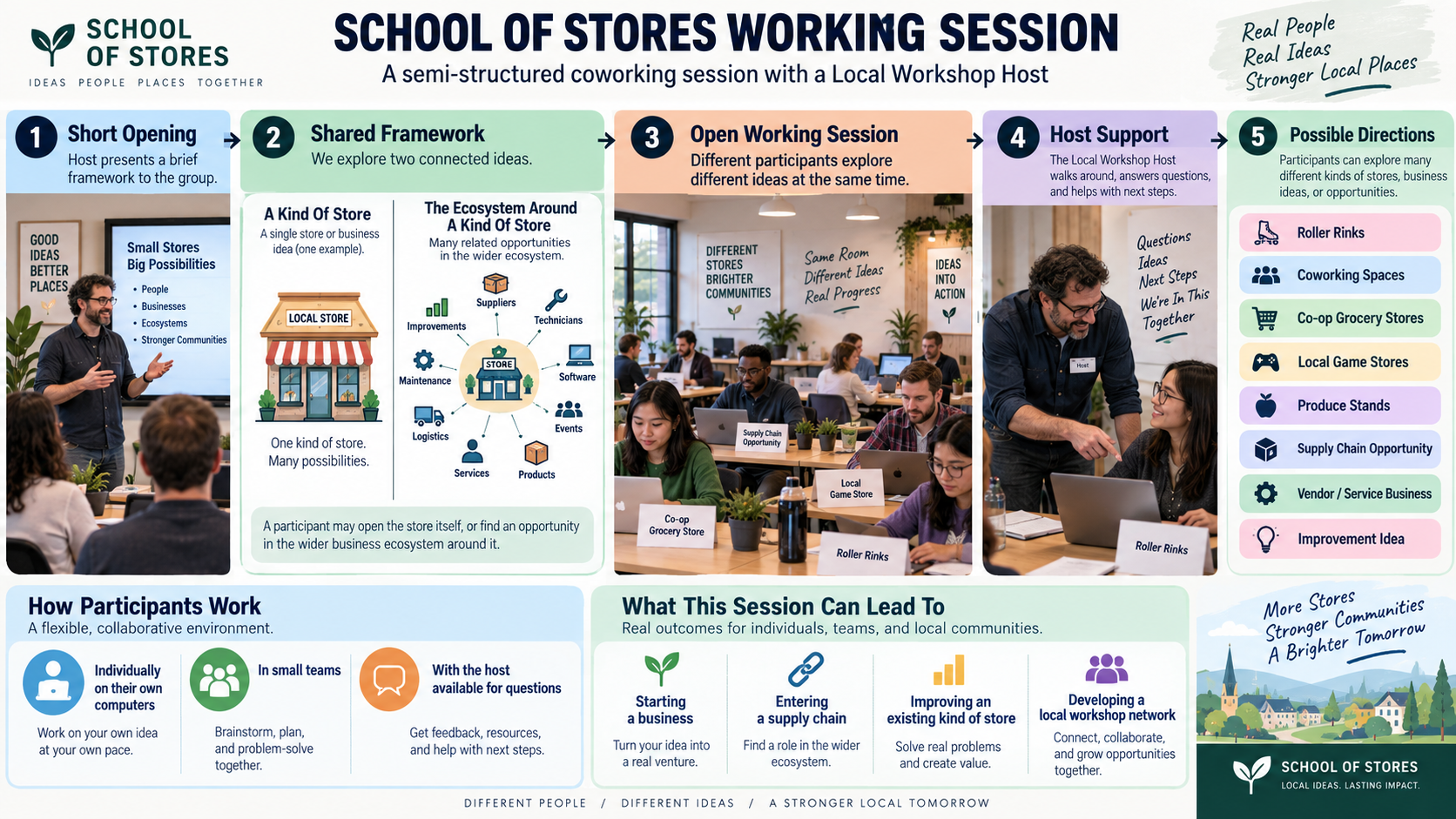
Local Workshop Hosts help bring School Of Stores into local communities. A host can organize small working sessions where people use School Of Stores research, Classes & Curriculum, Kinds Of Stores, Launchpads, Catalogs, and shared tools to explore ideas, identify local needs and opportunities, and move promising work toward real businesses, cooperatives, projects, media, or other useful outcomes. The host’s role is primarily facilitation: helping people find relevant material, work productively, capture results, and decide what to do next.
ART GALLERY
The Latest Visuals
BLOG CATEGORY
Local Workshop Hosts
Blog entries associated with Local Workshop Hosts appear here automatically.
MORE INFORMATION
What A Local Workshop Host Does
A Local Workshop Host facilitates rather than simply lectures. The host can help participants choose a topic, locate relevant School Of Stores material, organize individual or small-group work, keep a session moving, capture useful outcomes, and identify practical next steps.
MORE INFORMATION
Who Can Be A Host
A host could be an individual or small team: a store owner, educator, librarian, coworking-space operator, student, retiree, community organizer, maker, designer, entrepreneur, or another person willing to organize a useful local working session. School Of Stores does not currently require a formal host certification.
MORE INFORMATION
What A Workshop Can Work On
A workshop can focus on one Kind Of Store, a Launchpad, a local business idea, a cooperative or crowdfunding concept, a Catalog, a product idea, an attraction concept, a media project, a Course exercise, or a specific local need. Different participants do not have to work on the same subject.
MORE INFORMATION
A Typical Workshop Flow
A simple session can follow a lightweight sequence: arrive → choose a topic → review existing research → identify questions or opportunities → work individually or in small groups → share findings → record next steps. The format can remain flexible enough for the people, place, and project.
MORE INFORMATION
Small Is Fine
A Local Workshop does not have to be a conference. It could be three people around a library table, a family working on an idea together, six people in a coworking room, a group meeting at a Local Game Store, or a larger organized session. Useful participation matters more than scale.
MORE INFORMATION
Places To Host
Possible venues include libraries, Coworking Spaces, community rooms, schools and colleges, cafés with meeting space, makerspaces, local businesses, parks where appropriate, and Local Game Stores. Local Game Stores can be especially natural workshop venues because the School Of Stores model already treats them as community places for play tables, demos, clubs, events, and other in-person activity connected to Launchpad B.
MORE INFORMATION
School Of Stores Materials
Hosts can work with the School Of Stores website itself, Kind Of Store research, Classes & Curriculum, Launchpad pages, Catalogs, artwork and infographics, videos, and future worksheets or printed material. The goal is to make existing research usable in a local working environment.
MORE INFORMATION
Shared Tools & Resources
Local Workshops can eventually make use of finite shared resources such as computers, displays, projectors, cameras, microphones, reference books, software licenses, fabrication tools, or other equipment assigned to a workshop or Launchpad. A host can help schedule, steward, and document how shared resources are used.
MORE INFORMATION
Information Layer
Workshops should be able to produce information as well as consume it. Participants can identify wishes, needs, complaints, missing businesses, product ideas, research questions, supplier gaps, or opportunities. Useful observations can feed back into the School Of Stores Information Layer and become material for later research or projects.
MORE INFORMATION
Working With Classes & Curriculum
A host can organize an informal local working session around material from Classes & Curriculum without implying that School Of Stores currently operates a formal livestream or videoconference class program. The public Course material remains the source, while the local workshop gives people a place to work through it together.
MORE INFORMATION
Working Across Multiple Kinds Of Stores
A single workshop can support several projects at once. One table might work on a Produce Stand, another on a Local Game Store, and another on Playground Equipment Stores. The host facilitates the room, helps participants find relevant material, and makes useful cross-connections rather than forcing everyone through one topic.
MORE INFORMATION
Hosts, Experts & Guest Contributors
A workshop can sometimes benefit from accountants, designers, tradespeople, store operators, librarians, educators, planners, engineers, artists, or other specialists. Their participation should be presented as confirmed only when it is actually arranged; the Local Workshop Host role itself does not imply professional credentials in those fields.
MORE INFORMATION
Accessibility & Participation
Hosts should favor accessible venues and understandable materials, allow different ways of contributing, and make room for participants who prefer writing or small-group work rather than speaking to a whole room. Session length, physical access, language needs, sensory conditions, and technology access can all affect whether people can participate productively.
MORE INFORMATION
Safety, Boundaries & Professional Advice
Local Workshop Hosts are facilitators, not automatically lawyers, doctors, accountants, engineers, financial advisers, contractors, or safety inspectors. A workshop should identify when a project needs qualified professional guidance, permits, inspections, insurance, or other specialized support instead of treating a brainstorming session as a substitute for professional work.
MORE INFORMATION
Starting A Local Workshop
A low-friction starting sequence is enough: choose a place → choose a date and time → invite a few people → select one or more School Of Stores topics → make internet access, a display, or printed material available as needed → run the session → capture outcomes → decide whether to meet again.
MORE INFORMATION
What Success Looks Like
Success does not require a company to launch. A productive workshop might clarify an idea, answer a research question, identify a supplier, create a useful relationship, produce a draft Catalog page, define a cooperative concept, uncover a local need, or help someone decide that an idea is not worth pursuing. Each of those outcomes can improve the next decision.
MORE INFORMATION
Local Workshops As A Network
Over time, Local Workshop Hosts in different communities could operate independently while contributing useful findings back into the same School Of Stores system. That creates a pathway from website research → local working sessions → new information → projects, businesses, cooperatives, media, and further research. Launchpad B and Launchpad C already reference Local Workshop Hosts as participants in their wider development ecosystems.
ART ARCHIVE
Visual Records