
ABOUT
From Curiosity to Invention
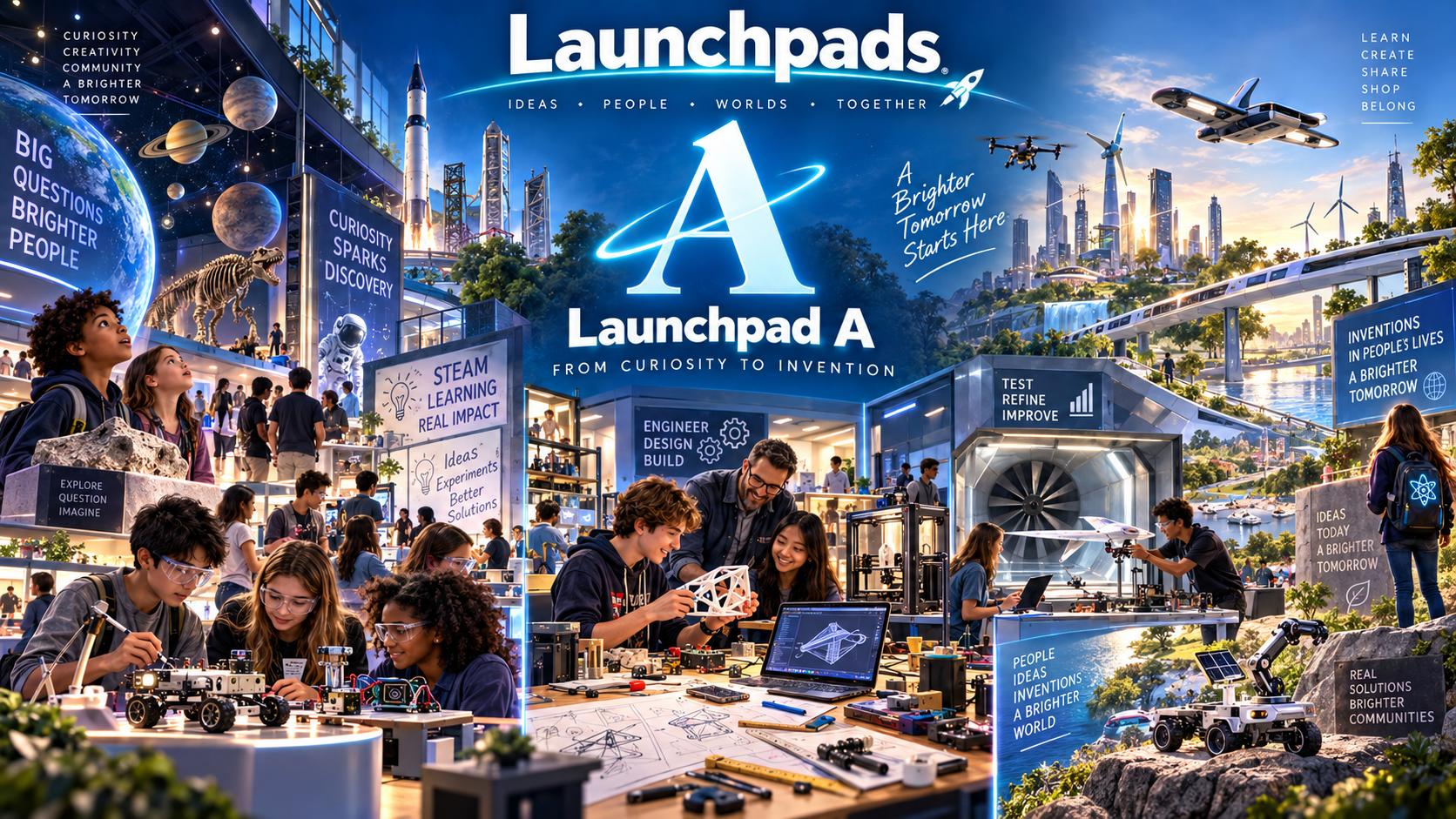
Launchpad A is the School Of Stores pathway for science, engineering, invention, aerospace, STEAM education, SciMu-style discovery, prototyping, testing, and the real systems that can grow around useful ideas. It begins with questions and learning, gives people places and tools to experiment, and makes room for projects to move from sketches and models toward prototypes, businesses, products, stores, and other real-world applications.
ART GALLERY
STEAM EDUCATION
Curiosity Is A Starting Point
Launchpad A begins with the kinds of questions that make people want to understand how something works, why a problem exists, or whether a different solution is possible. Science, technology, engineering, art, and mathematics can become practical tools for answering those questions through observation, research, experiments, models, design, building, testing, and revision.
LEARNING ENVIRONMENTS
More Than One Classroom
Learning can happen in schools, museums, libraries, makerspaces, workshops, laboratories, clubs, community spaces, businesses, outdoor settings, homes, and temporary project spaces. Launchpad A can connect these environments so a learner does not have to treat each one as an isolated experience. A question encountered in one place can become a project in another and eventually become something useful in the world.
INTEGRAL KIND OF STORE
Binocular & Telescope Stores
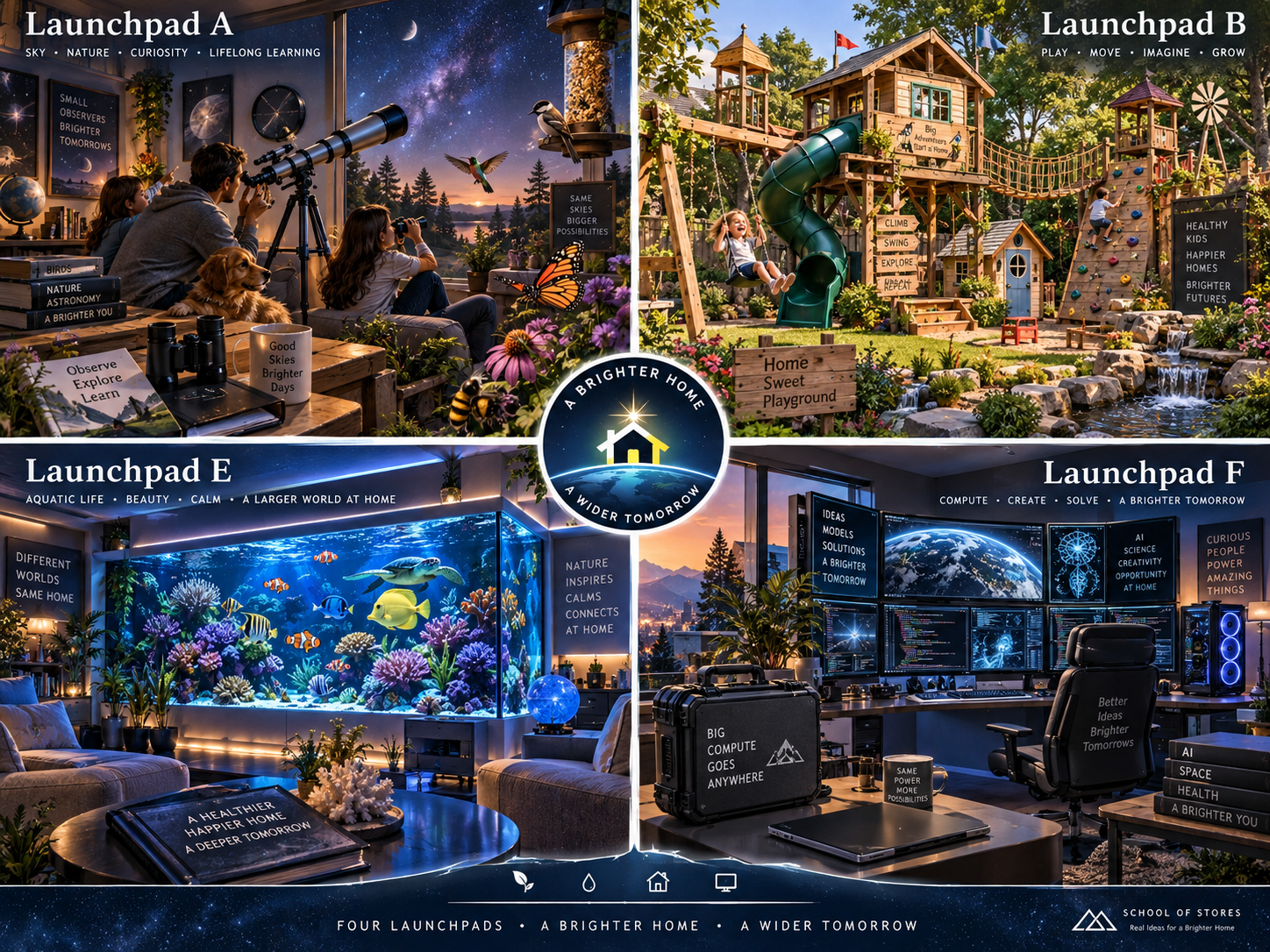
Binocular & Telescope Stores are an Integral Kind Of Store for Launchpad A because observation can begin at home and continue anywhere a person can look up or look outward. Telescopes can support astronomy, a telescope room, a home observatory, or a planetarium-style learning room; binoculars can support birdwatching from a window, yard, park, or neighborhood walk. Nearby Bird Feeder Stores can make birds easier to observe at home, while butterflies, bees, pollinator gardens, and potential home beekeeping through Beekeeping Supply Stores expand the same everyday nature-learning idea. Birds, butterflies, and bees are also flying creatures, so observing wings, lift, maneuvering, efficiency, and behavior can lead naturally into aerodynamics, biomimicry, aerospace engineering, and questions about future human flying systems.
SCIMU
Explore, Experiment & Build
SciMu represents the science-museum and hands-on discovery side of this pathway: environments where exhibits, demonstrations, experiments, collections, technology, art, and making can sit close together. Launchpad A can utilize that kind of setting as a bridge between learning about an idea and trying to build, test, or improve something because of it.
ENGINEERING & INVENTION
Design, Build, Test, Improve
An invention pathway should make iteration normal. A sketch can become a digital model; a model can become a physical prototype; a prototype can be measured, tested, broken, repaired, and improved. Some ideas will stop at a useful experiment. Others may become products, services, businesses, public systems, vehicles, educational tools, or new kinds of stores. Launchpad A makes those intermediate steps visible instead of pretending that invention happens in one leap.
SHARED RESOURCES
Put Scarce Tools Where Teams Can Use Them
Some tools, facilities, machines, software seats, test equipment, vehicles, and specialized workspaces are too scarce or expensive for every participant to own. Launchpad A can become a stewardship point for assigning appropriate shared resources to teams, scheduling their use, teaching safe operation, and keeping valuable equipment productive across multiple educational and creative projects.
INTEGRAL KIND OF STORE
Flying Car Stores
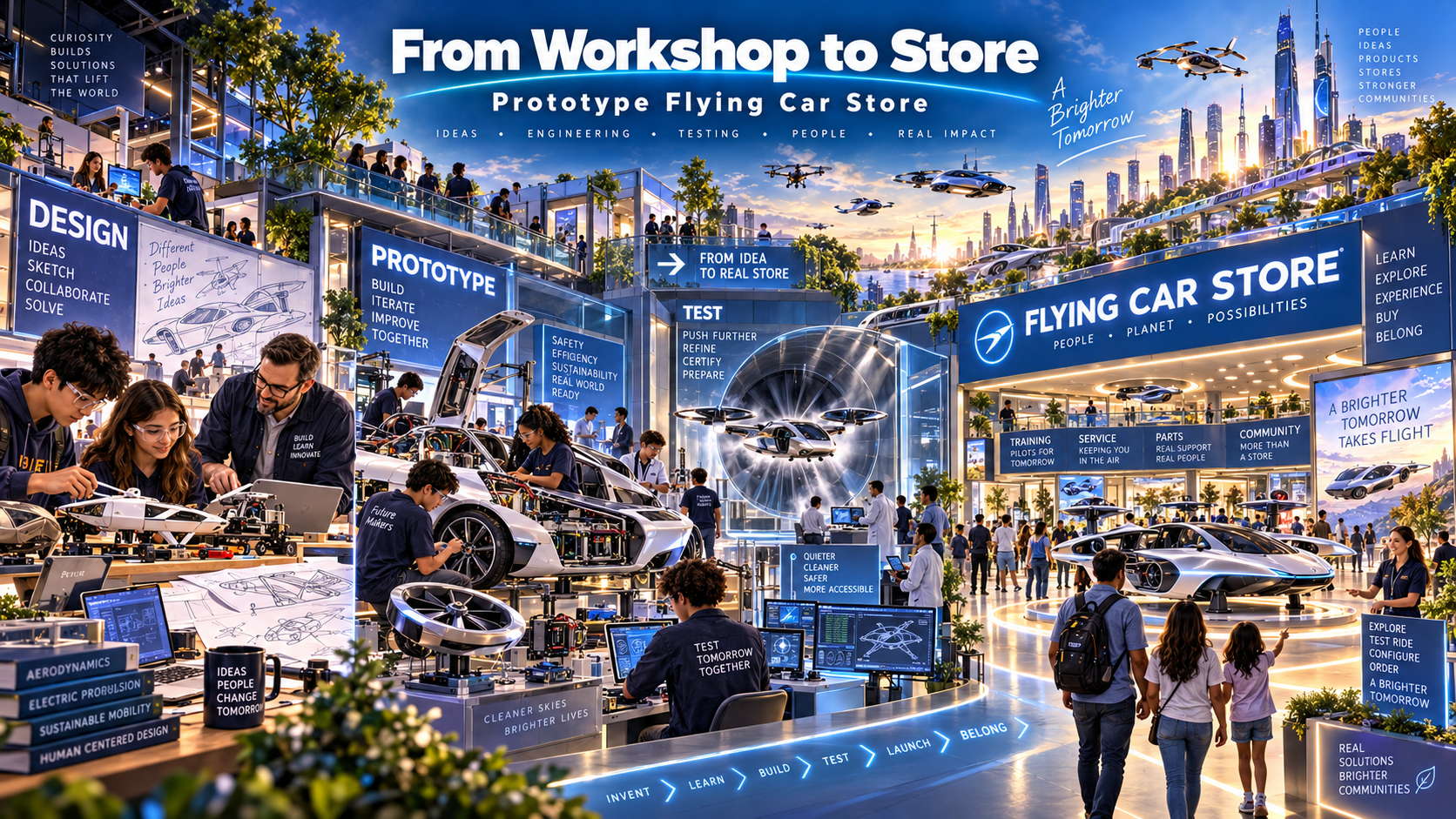
Flying Car Stores are an Integral Kind Of Store for Launchpad A. A prototype Flying Car Store is also a concrete case study because it requires much more than displaying a futuristic vehicle. The store can connect engineering and invention to a customer-facing environment where people encounter vehicles, ask questions, compare concepts, learn what is practical, and see how a new transportation category might need sales, demonstrations, training, maintenance, parts, safety knowledge, financing, infrastructure, and continuing technical support.
FROM WORKSHOP TO STORE
A Prototype Can Become A System
The workshop is only one stage. A project that becomes useful may need manufacturing, supply chains, documentation, testing, service procedures, trained workers, public education, retail presentation, customer feedback, and places where people can safely experience the technology. The Prototype Flying Car Store image treats the store itself as an experiment: a place where the invention and the surrounding business system can be designed together.
ENTREPRENEURSHIP
Many Businesses Can Grow Around One Invention
A successful invention can create opportunities far beyond the company that designed the original object. Component suppliers, software teams, educators, repair specialists, installers, infrastructure providers, retailers, trainers, manufacturers, logistics companies, designers, researchers, and other entrepreneurs may all contribute. Launchpad A can help people see those surrounding opportunities early enough to build projects around them.
REAL-WORLD FEEDBACK
Learning Continues After Launch
Putting a prototype, product, or store in front of real people creates new information. Customers ask questions engineers may not have expected. Service teams discover maintenance problems. Teachers find better ways to explain the technology. Users imagine new applications. That feedback can return to the learning and engineering environments and begin another cycle of research, design, testing, and improvement.
LIFELONG LEARNING
All Ages · All Places · All Possibilities
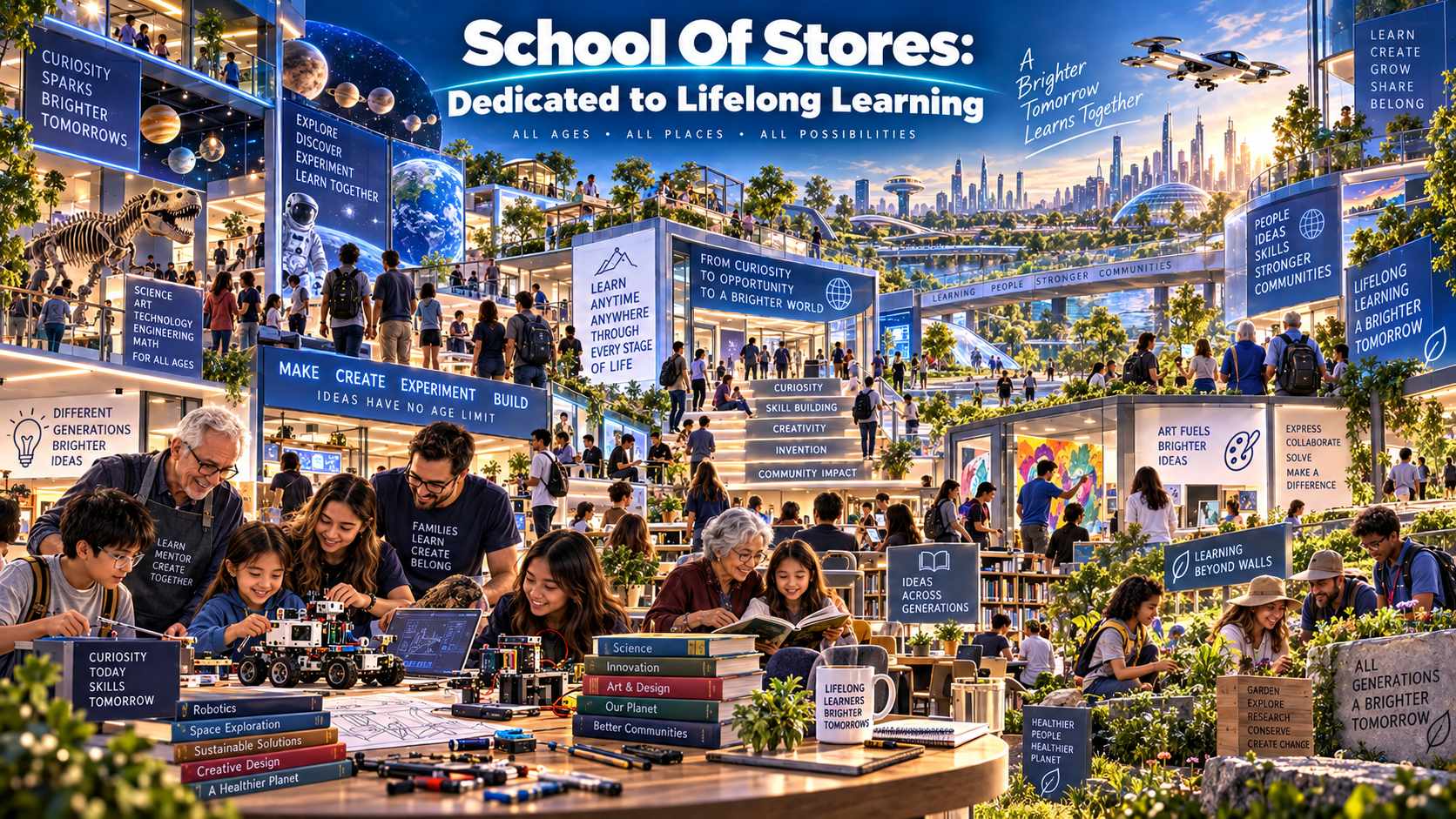
School Of Stores can treat education as an ongoing creative journey rather than something that ends when formal schooling ends. A young student can encounter STEAM through school or a museum, return with a parent to a workshop, learn from an older mentor, participate in a community project, become an engineer or entrepreneur, and later teach or mentor someone else. Older adults can continue learning new tools and subjects while contributing experience that younger participants do not yet have.
FAMILIES & MENTORS
Students Do Not Have To Learn Alone
Parents and other family members can participate alongside students instead of being limited to drop-off and pickup. Multi-age settings can also include teachers, retirees, working professionals, craftspeople, scientists, engineers, artists, entrepreneurs, and other mentors. The goal is not to erase age-appropriate instruction; it is to create additional settings where generations can learn from one another while working on real questions and projects.
CLASSES & CURRICULUM
Guest Instructors & Complete Learning Paths
The School Of Stores Classes & Curriculum area can turn parts of Launchpad A into teachable sequences instead of isolated demonstrations. Complete curricula can combine lessons, projects, reading, experiments, visits, equipment use, and guest instructors or subject-matter contributors. A student might meet a topic in a class and then continue it through a museum, workshop, store, business, or independent project.
THE LOOP
Learners Become Builders; Builders Become Mentors
Launchpad A is a loop. Curiosity leads to learning; learning leads to experiments; experiments lead to skills and prototypes; prototypes create new questions; real-world use creates feedback; and experienced participants can return as mentors, instructors, collaborators, investors, customers, or founders. Lifelong learning gives the system a way to renew itself across generations.
THE LAUNCHPADS
Connected, Not Isolated
Launchpad A is the science, engineering, invention, aerospace, STEAM, SciMu, and lifelong-learning pathway. Launchpad B develops IP, entertainment, games, comics, products, and attractions. Launchpad C is the Catalogs, modeling, cheer, fashion-show, media, customer-service, and commerce pathway. The Launchpads can exchange people, tools, technologies, stories, products, audiences, and production capabilities rather than operating as sealed departments.
MORE INFORMATION
Launchpad A Opportunities
Participation can eventually include students, families, teachers, guest instructors, scientists, engineers, inventors, museums, makerspaces, laboratories, universities, manufacturers, component suppliers, retailers, startups, cooperative-development teams, crowdfunding experiments, testing facilities, and people who simply have a question they want to explore. The purpose of the pathway is to make it easier to see where learning can turn into making, where making can turn into useful systems, and where experienced participants can help the next group begin.
ART ARCHIVE
Visual Records