
ABOUT
Information
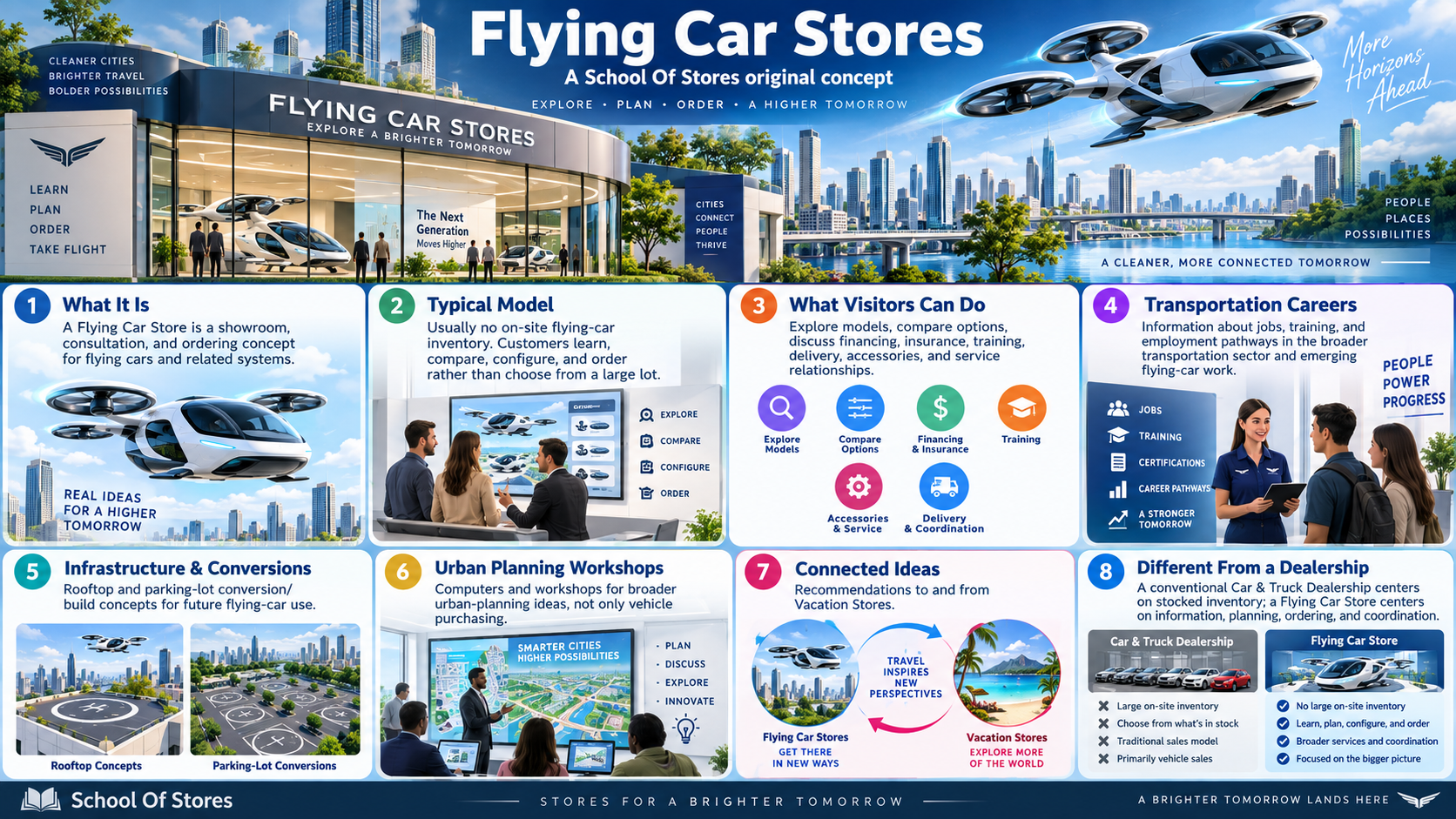
Flying Car Stores are a School Of Stores original concept for physical places that help people participate in an emerging transportation ecosystem without operating like conventional vehicle dealerships. A typical Flying Car Store would generally keep no flying-car inventory on-site. Instead, it can combine vehicle education, comparison, configuration, ordering and delivery coordination with transportation-sector employment pathways, computers and workshops for urban planning, coordination of rooftop and parking-lot infrastructure conversions, and reciprocal recommendations with Vacation Stores. Temporary vehicle demonstrations may occur, but stocked on-site inventory is not the defining model.
ART GALLERY
The Latest Visuals

BLOG CATEGORY
Flying Car Stores
Blog entries associated with Flying Car Stores appear here automatically.
Watch Co-op & Crowdfund Develop in Real Time
September 23, 2026
Launchpads For A Brighter Tomorrow
September 23, 2026
Dreams Take Flight! And Information Layer
September 19, 2026
EMAIL OUTREACH
Reaching Out About Flying Car Stores
School Of Stores can reach out to advanced-air-mobility manufacturers and operators, transportation employers, aviation and urban-planning professionals, local governments, infrastructure contractors, training providers, insurers, lenders, software companies, travel businesses, property owners, community organizations, and prospective customers to test and improve the Flying Car Stores concept.
MORE INFORMATION
Number Of Flying Car Stores
There is no established count of Flying Car Stores because this is a School Of Stores original retail concept rather than an existing statistical industry category. Current advanced-air-mobility activity is better measured through aircraft, infrastructure, pilot programs, operators, manufacturers, and related transportation projects.[1][2]
MORE INFORMATION
Number Of Flying Car Stores
Footnotes
- Federal Aviation Administration. Advanced Air Mobility Implementation Plan. July 18, 2023; accessed September 19, 2026. FAA plan describing the coordinated work needed to safely enable advanced-air-mobility operations, including aircraft, pilots, airspace, infrastructure, security, energy, labor, governments, and communities.
- Federal Aviation Administration. Eight Selections for the Advanced Air Mobility and eVTOL Integration Pilot Program. March 9, 2026. FAA announcement of eight real-world proposals selected for the 2026 AAM/eVTOL integration pilot program.
MORE INFORMATION
Trade Associations & Industry Events
Flying Car Stores would sit at the intersection of advanced air mobility, autonomy, aviation, transportation, infrastructure, planning, and retail. AUVSI’s XPONENTIAL is one useful cross-industry event, while FAA AAM programs provide the regulatory and infrastructure context.[1][3]
MORE INFORMATION
Trade Associations & Industry Events
Footnotes
- Association for Uncrewed Vehicle Systems International. XPONENTIAL 2026. May 11–14, 2026. Cross-domain autonomy and robotics event with advanced-air-mobility, infrastructure, policy, manufacturing, and industry participation.
- Federal Aviation Administration. Advanced Air Mobility Implementation Plan. July 18, 2023; accessed September 19, 2026. FAA plan describing the coordinated work needed to safely enable advanced-air-mobility operations, including aircraft, pilots, airspace, infrastructure, security, energy, labor, governments, and communities.
MORE INFORMATION
Vendors & Supporting Services
A Flying Car Store could rely on vehicle manufacturers and operators, finance and insurance providers, training companies, simulation and display systems, urban-planning software, contractors, electrical and charging services, rooftop and parking-lot specialists, communications networks, travel partners, and many other supporting businesses.[4]
MORE INFORMATION
Vendors & Supporting Services
Footnotes
- Federal Aviation Administration. Advanced Air Mobility Infrastructure. Accessed September 19, 2026. FAA guidance on vertiport design and construction, including Engineering Brief 105A and existing notification/aeronautical-study requirements.
MORE INFORMATION
Starting A Flying Car Store
Starting a Flying Car Store would mean testing a new service-heavy store format rather than opening a conventional vehicle lot: define the no-inventory model, the customer and workforce services, the urban-planning workshop area, supplier relationships, infrastructure referrals, and the legal boundaries of any aviation-related activity.[5]
MORE INFORMATION
Starting A Flying Car Store
Footnotes
- Federal Aviation Administration. Advanced Air Mobility Infrastructure. Accessed September 19, 2026. FAA guidance on vertiport design and construction, including Engineering Brief 105A and existing notification/aeronautical-study requirements.
- U.S. Small Business Administration. Plan your business. Accessed September 19, 2026. Small-business planning resources covering market research, business plans, startup costs, funding, and counseling.
MORE INFORMATION
Websites & Apps For Flying Car Stores
A Flying Car Store can combine a public B2C website, a private staff intranet, networked planning workstations, B2B manufacturer and infrastructure integrations, transportation-employment tools, workshop systems, and referrals to and from Vacation Stores.
MORE INFORMATION
Websites & Apps For Flying Car Stores
MORE INFORMATION
Rewards & Equity Crowdfunds For Flying Car Stores
Rewards crowdfunding could help test workshops, memberships, planning labs, educational materials, or a pilot Flying Car Store, while any equity crowdfunding would be a securities offering subject to a separate legal framework such as Regulation Crowdfunding.[6]
MORE INFORMATION
Rewards & Equity Crowdfunds For Flying Car Stores
Footnotes
- U.S. Securities and Exchange Commission. Exempt Offerings — Regulation Crowdfunding. Updated January 26, 2026. SEC overview stating that Regulation Crowdfunding can permit eligible companies to offer up to $5 million in securities through a registered intermediary.
MORE INFORMATION
Supply Chain Opportunities
The supply chain around Flying Car Stores extends far beyond vehicles: infrastructure conversions, electrical systems, planning tools, training, recruitment, software, communications, insurance, finance, maintenance, travel, accessibility, and community engagement can all become businesses that serve the store or its customers.[1][4]
MORE INFORMATION
Supply Chain Opportunities
Footnotes
- Federal Aviation Administration. Advanced Air Mobility Implementation Plan. July 18, 2023; accessed September 19, 2026. FAA plan describing the coordinated work needed to safely enable advanced-air-mobility operations, including aircraft, pilots, airspace, infrastructure, security, energy, labor, governments, and communities.
- Federal Aviation Administration. Advanced Air Mobility Infrastructure. Accessed September 19, 2026. FAA guidance on vertiport design and construction, including Engineering Brief 105A and existing notification/aeronautical-study requirements.
MORE INFORMATION
Opportunities For Improvement
The concept can improve by making transportation technology understandable without requiring on-site inventory, connecting customers with jobs and training, turning store computers into practical urban-planning workshops, developing responsible infrastructure-referral systems, and coordinating travel recommendations with Vacation Stores.
MORE INFORMATION
Opportunities For Improvement
MORE INFORMATION
History Of Flying Car Stores
Flying Car Stores do not yet have an established retail history as a recognized industry category; School Of Stores is proposing a new store format informed by vehicle showrooms, aviation sales and training, travel agencies, employment centers, planning workshops, and the developing advanced-air-mobility ecosystem.[1][7]
MORE INFORMATION
History Of Flying Car Stores
Footnotes
- Federal Aviation Administration. Advanced Air Mobility Implementation Plan. July 18, 2023; accessed September 19, 2026. FAA plan describing the coordinated work needed to safely enable advanced-air-mobility operations, including aircraft, pilots, airspace, infrastructure, security, energy, labor, governments, and communities.
- Federal Aviation Administration. Urban Air Mobility Concept of Operations. Updated August 31, 2023; accessed September 19, 2026. FAA conceptual framework describing AAM transportation of people and cargo across urban, rural, local, regional, and intraregional locations using new aircraft, infrastructure, and operations.
ART ARCHIVE
Visual Records

FOOTNOTES
Sources
- Federal Aviation Administration. Advanced Air Mobility Implementation Plan. July 18, 2023; accessed September 19, 2026. FAA plan describing the coordinated work needed to safely enable advanced-air-mobility operations, including aircraft, pilots, airspace, infrastructure, security, energy, labor, governments, and communities.
- Federal Aviation Administration. Eight Selections for the Advanced Air Mobility and eVTOL Integration Pilot Program. March 9, 2026. FAA announcement of eight real-world proposals selected for the 2026 AAM/eVTOL integration pilot program.
- Association for Uncrewed Vehicle Systems International. XPONENTIAL 2026. May 11–14, 2026. Cross-domain autonomy and robotics event with advanced-air-mobility, infrastructure, policy, manufacturing, and industry participation.
- Federal Aviation Administration. Advanced Air Mobility Infrastructure. Accessed September 19, 2026. FAA guidance on vertiport design and construction, including Engineering Brief 105A and existing notification/aeronautical-study requirements.
- U.S. Small Business Administration. Plan your business. Accessed September 19, 2026. Small-business planning resources covering market research, business plans, startup costs, funding, and counseling.
- U.S. Securities and Exchange Commission. Exempt Offerings — Regulation Crowdfunding. Updated January 26, 2026. SEC overview stating that Regulation Crowdfunding can permit eligible companies to offer up to $5 million in securities through a registered intermediary.
- Federal Aviation Administration. Urban Air Mobility Concept of Operations. Updated August 31, 2023; accessed September 19, 2026. FAA conceptual framework describing AAM transportation of people and cargo across urban, rural, local, regional, and intraregional locations using new aircraft, infrastructure, and operations.