
ABOUT
Course Overview
Co-op & Crowdfund is a School Of Stores course about how people can organize, finance, build, and sustain shared ventures through cooperatives, crowdfunding, and related forms of collective action. The course connects cooperative structures, member and consumer participation, rewards crowdfunding, equity crowdfunding, community capital, and practical project development while keeping the different purposes and obligations of those tools clear.
Planned length: approximately three months, probably one class per week. The course now has an initial framework of thirteen classes; individual classes can continue to grow as research, readings, exercises, experts, and projects are developed.
At this stage, livestream or videoconference classes are not planned. They remain possible in the future; the current focus is building and refining the curriculum publicly on School Of Stores.
ART GALLERY
The Latest Visuals
BLOG CATEGORY
Co-op & Crowdfund
Blog entries associated with Co-op & Crowdfund appear here automatically.
Watch Co-op & Crowdfund Develop in Real Time
September 23, 2026
CONCURRENT LAB COURSE
Science Fiction Creative Writing Lab
The lab runs alongside the Co-op & Crowdfund course schedule. Class 1 introduces a creative-writing prompt; Classes 3, 6, 9, and 12 provide progress check-ins; Class 13 looks at results. Participants can write a sentence, a paragraph, a page, or more, and the instructor participates from the same prompt.
CORE TEXTBOOK
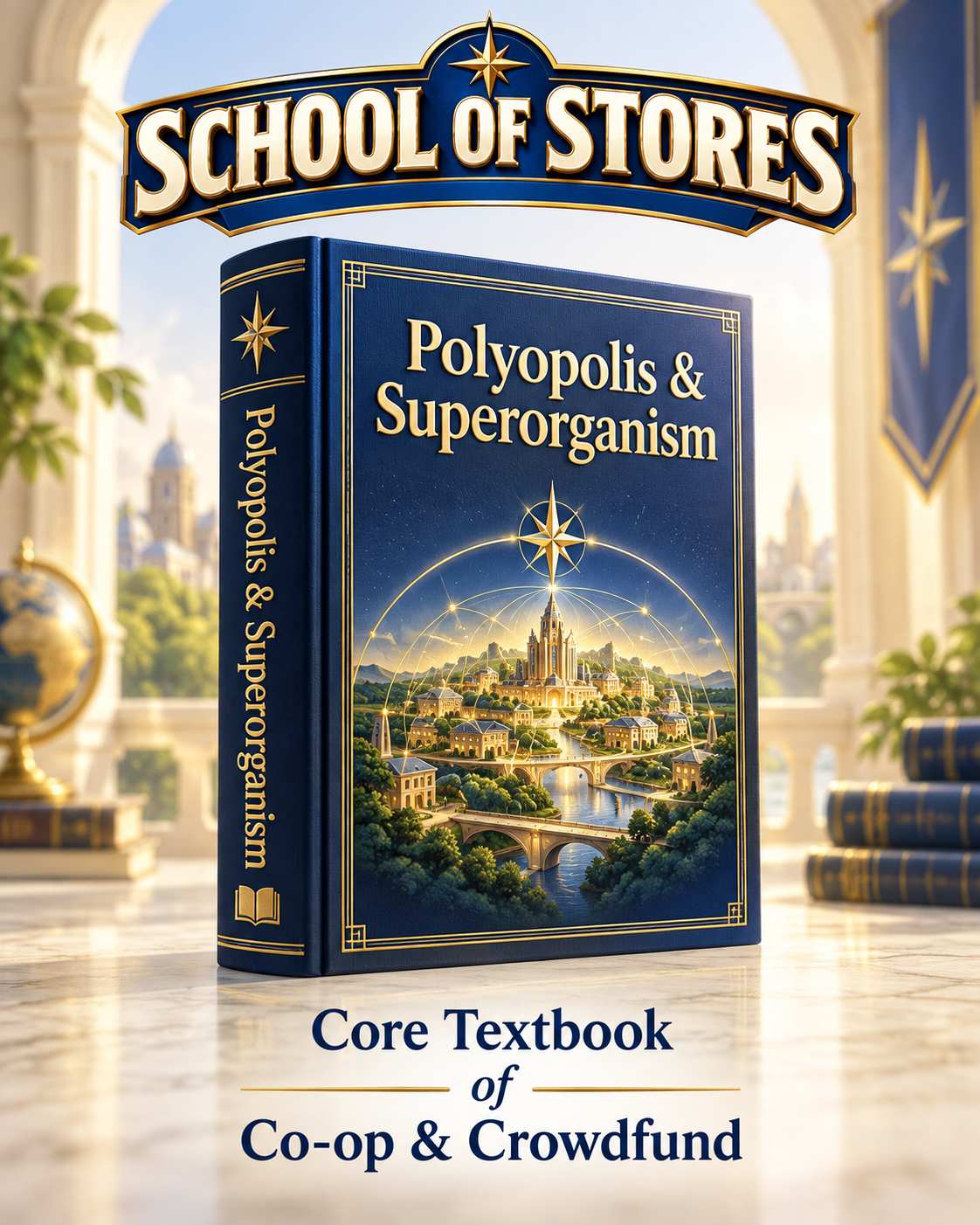
Polyopolis & Superorganism
From School Of Stores
Jesse Ryan Jensen, Editor-in-Chief
Polyopolis & Superorganism is the organizing text for Co-op & Crowdfund. Lessons, discussions, exercises, case studies, and future guest contributions can build around the concepts and questions developed through the textbook.
Foreword — Why School Of Stores
User Prompt
if the core textbook is about the human mind, the ideas of civilization and behavior of the human animal in physical space over time, interpersonal behavior and economics, etc. then if the Internet Science Museum were the factual data and theory of the history of the natural world of planet Earth, and the human presence and management of the Moon were third, and human civilization on Mars were the fourth frame of reference at this scale, relate how the frame of reference of calling the website and project "School Of Stores" hearkens back to the early transition of the human species from being hunter-gatherers to agriculture, and specifically how the forced imposition of monoculture agriculture and the feudalism frame of reference of a lord holding the food crop in a storehouse and how the idea of that being smarter because planning for the future, but the moral hazard of accepting slavery and totalitarian government and hierarchical social structure compared to hunter-gatherer groups where everyone in the tribe enjoyed total membership or banishment/ostracization.
ChatGPT Reply
At that scale, School Of Stores becomes a much deeper name than “a school about retail.” It can stand for the point in human history when the store—the deliberate accumulation, protection, accounting, allocation, and exchange of resources—became one of the basic technologies of civilization.
Your four frames of reference then fit together unusually well. Polyopolis & Superorganism studies the human animal itself: mind, behavior, relationships, economics, institutions, and how people organize themselves through physical space and time. The Internet Science Museum supplies the larger factual frame of the natural history of Earth—the biological and physical world in which human civilization arose. The Moon becomes a frame for human beings deliberately managing a world where almost everything necessary for life must be planned and supplied. Mars goes further: not merely managing an outpost, but asking what an entire human civilization might look like when many inherited assumptions have to be reconsidered.
Seen that way, School Of Stores sits right at the hinge between natural history and civilization.
A hunter-gatherer band largely lives inside ecological flows. Food is found, hunted, gathered, shared, consumed, and moved toward. Storage certainly existed among foragers, sometimes extensively, but mobility limited how much accumulation could dominate everyday life. Agriculture changed the possibilities enormously. Once food production became concentrated in particular places and seasons, a society could create a substantial surplus. A surplus could be placed somewhere. Once it could be placed somewhere, somebody could count it, guard it, distribute it, lend it, tax it, inherit it, steal it, or deny somebody access to it.
That is the conceptual birth of the store as an institution.
And the storehouse contains one of civilization's fundamental paradoxes.
It is obviously intelligent to prepare for tomorrow. A granary can keep people alive after a bad harvest. Stored seed makes another planting possible. Surplus can support specialists who are not producing food every day: builders, teachers, physicians, artists, soldiers, engineers, administrators. Storage permits long-term projects. It allows a society to think beyond today's meal.
So the person saying “we should put some of this away for the future” may be completely right.
But the moment the community's continued survival depends upon the stored surplus, an extraordinary political question appears:
Who controls the door?
That person or institution now possesses something more consequential than ordinary property. It can possess leverage over everybody whose survival depends on what is inside.
That is where your idea about moral hazard becomes powerful. The same institutional structure that produces prudent planning can also produce domination. A ruler can say, in effect: We must organize production this way because civilization requires foresight. We must collect the grain because somebody has to protect the future. We must record who produced what. We must decide who receives what. We must require labor because the system has to continue functioning.
Every one of those propositions can have a practical justification. Together, however, they can become the architecture of hierarchy.
And standardized agriculture can intensify that tendency. It is worth being historically careful here: early agriculture was not universally imposed, it was not uniformly monocultural, and feudalism comes thousands of years after the earliest agricultural transitions. But in many later agrarian states, rulers strongly preferred crops and production systems that were concentrated, measurable, storable, divisible, and taxable. Where political authorities imposed standardized staple production or controlled land and harvests, the storehouse could become not merely a safety device but an instrument of administration.
The contrast with many mobile hunter-gatherer societies is therefore interesting, although that comparison also needs nuance. Hunter-gatherer societies were highly diverse and were not universally egalitarian. Still, many mobile foraging societies historically displayed much flatter political structures than agricultural states. One reason is material: it is difficult for somebody to monopolize vast immovable wealth when people can move away, possessions are limited, and subsistence knowledge is broadly distributed.
That changes the balance of power.
In a small band, an individual may have substantial standing simply by being a recognized member of the group. There can certainly be leaders, prestige, gender roles, conflict, punishment, and exclusion. Ostracism or expulsion can also be devastating precisely because group membership matters so much. But there may be relatively little institutional space for an enormous permanent bureaucracy separating the person at the bottom from the person controlling subsistence.
An agrarian hierarchy can create something very different:
landlord → administrator → overseer → tenant/serf/laborer → stored crop
Now access to food, land, security, inheritance, and political standing can become mediated by institutional rank.
And that helps illuminate why the rise of civilization can simultaneously look like an extraordinary human achievement and an extraordinary loss of autonomy.
The dangerous inference would be that agriculture itself “caused slavery” or that hunter-gatherers lived in an idyllic moral state. Human societies are far messier than that. Slavery and extreme violence have existed in societies with very different subsistence systems. But large stored surpluses, fixed territory, concentrated property, administrative recordkeeping, and populations that cannot easily leave can make coercive hierarchy much more scalable.
That distinction is important for your project.
The question isn't:
Was civilization a mistake?
The more interesting question is:
How do we preserve the intelligence of the storehouse without automatically reproducing the lord of the storehouse?
That gets directly to Co-op & Crowdfund.
A cooperative is, in one sense, an attempt to separate the benefits of organized accumulation from the assumption that the accumulated resource therefore needs a single superior owner. The group can still plan. It can still save. It can still own buildings, inventories, machinery, intellectual property, financial reserves, computers, vehicles, and food. But governance of the stored resources can be distributed among the people participating in the system.
Crowdfunding asks a related question from another direction: Who gets to assemble the surplus needed to make something happen?
Historically, the answer might have been a king, lord, wealthy merchant, bank, aristocrat, corporation, or state treasury. Modern crowdfunding creates another possible mechanism: many people can voluntarily aggregate relatively small resources toward an agreed objective.
So there is almost a straight conceptual line:
hunter-gathering → agriculture → surplus → storehouse → administration → ownership → hierarchy → markets → stores → corporations → cooperatives/crowdfunding → School Of Stores
Not because history literally unfolded as one neat sequence, but because each stage raises the same underlying question:
How should humans organize access to resources that exist now so that human beings can live later?
That also explains why stores can be an unexpectedly good lens for studying almost everything else in your project. A grocery store contains agriculture, logistics, nutrition, labor, property, finance, architecture, transportation, refrigeration, energy, regulation, information, culture, and human psychology. A store is almost a miniature civilization.
And once you carry that question to the Moon or Mars, the metaphor becomes literal again.
On Mars, everybody's life may depend upon stored oxygen, water, food, energy, replacement parts, medicines, seeds, computing capacity, and habitat volume. The ancient question returns in an extreme form:
Who controls the storehouse?
If a Mars settlement's oxygen reserves belong to one person, that isn't merely a retail arrangement. It is political power over breathing.
So the Moon and Mars frames can function almost like laboratory conditions for the questions Polyopolis & Superorganism raises about Earth. Strip away the enormous inherited infrastructure of terrestrial civilization, and suddenly fundamental questions become visible again: What belongs to the individual? What belongs to the group? What should be rationed? What should be abundant? Who maintains reserves? Who decides distribution? What happens when someone refuses the rules? What rights exist independent of contribution? What does membership mean?
That makes School Of Stores a surprisingly appropriate umbrella.
The “store” is where biology becomes economics, foresight becomes administration, cooperation can become hierarchy, and civilization begins arguing with itself about who owns tomorrow.
That could eventually be a foundational passage explaining why the project is called School Of Stores.
COURSE MATERIALS
Lessons, Readings & Exercises
Co-op & Crowdfund is being developed in public. These expandable class sections are working course material and can continue to grow as research, readings, exercises, examples, expert outreach, and projects are added.
COURSE OUTLINE
Working Curriculum
The course is planned to run for approximately three months, probably at a rhythm of one class per week. Its initial thirteen-class framework moves from the origins of cooperative and crowdfunding ideas into neighborhood systems, aquariums and environmental thinking, the house as a bundle of functions, transportation, health and population, multigenerational space travel, extinction and planetary risk, computer science, infinity and utopianism, sluggish change, and personal and social responsibility.
The framework is intentionally able to grow. Research, exercises, media, expert contributions, and future dedicated class pages can deepen individual classes without changing the overall sequence.
EXPERTS & GUEST CONTRIBUTORS
Outreach by Class
Outside experts can be contacted for interviews, comments, source recommendations, short recorded contributions, or possible future participation. No person should be represented as participating until an actual contribution or commitment exists.
- Class 1: cooperative-economics researchers, crowdfunding specialists, securities-law experts, and historians of cooperatives.
- Class 2: urban planners, neighborhood designers, community-development professionals, librarians, Local Game Store operators, and shared-mobility researchers.
- Class 3: marine biologists, aquarists, oceanographers, aquarium-store professionals, conservation scientists, and environmental educators.
- Classes 4–5: architects, housing researchers, cohousing experts, building scientists, sociologists, and cooperative-housing organizers.
- Class 6: transportation planners, autonomous-vehicle researchers, aviation engineers, eVTOL specialists, transit researchers, and mobility cooperatives.
- Class 7: physicians, nurses, public-health researchers, veterinarians, sex educators, demographers, geneticists, bioethicists, historians of medicine, historians of Germany and Japan, historians of banking and political economy, legal scholars, Cold War historians, and feminist historians.
- Class 8: aerospace engineers, astrobiologists, space-habitat designers, closed-loop life-support researchers, psychologists studying isolation, and space-law scholars.
- Class 9: paleontologists, ecologists, conservation biologists, evolutionary biologists, climate scientists, and biodiversity researchers.
- Class 10: computer scientists, software engineers, AI researchers, cybersecurity specialists, distributed-systems researchers, and human-computer-interaction researchers.
- Class 11: mathematicians, philosophers of mathematics, cosmologists, historians of utopian thought, philosophers, and science-fiction scholars.
- Class 12: historians, sociologists, behavioral economists, organizational-change researchers, and technology-adoption scholars.
- Class 13: historians of counterculture, religious-studies scholars, sociologists, ethicists, psychologists, historians of astrology and New Age movements, and community organizers.