
ABOUT
Information
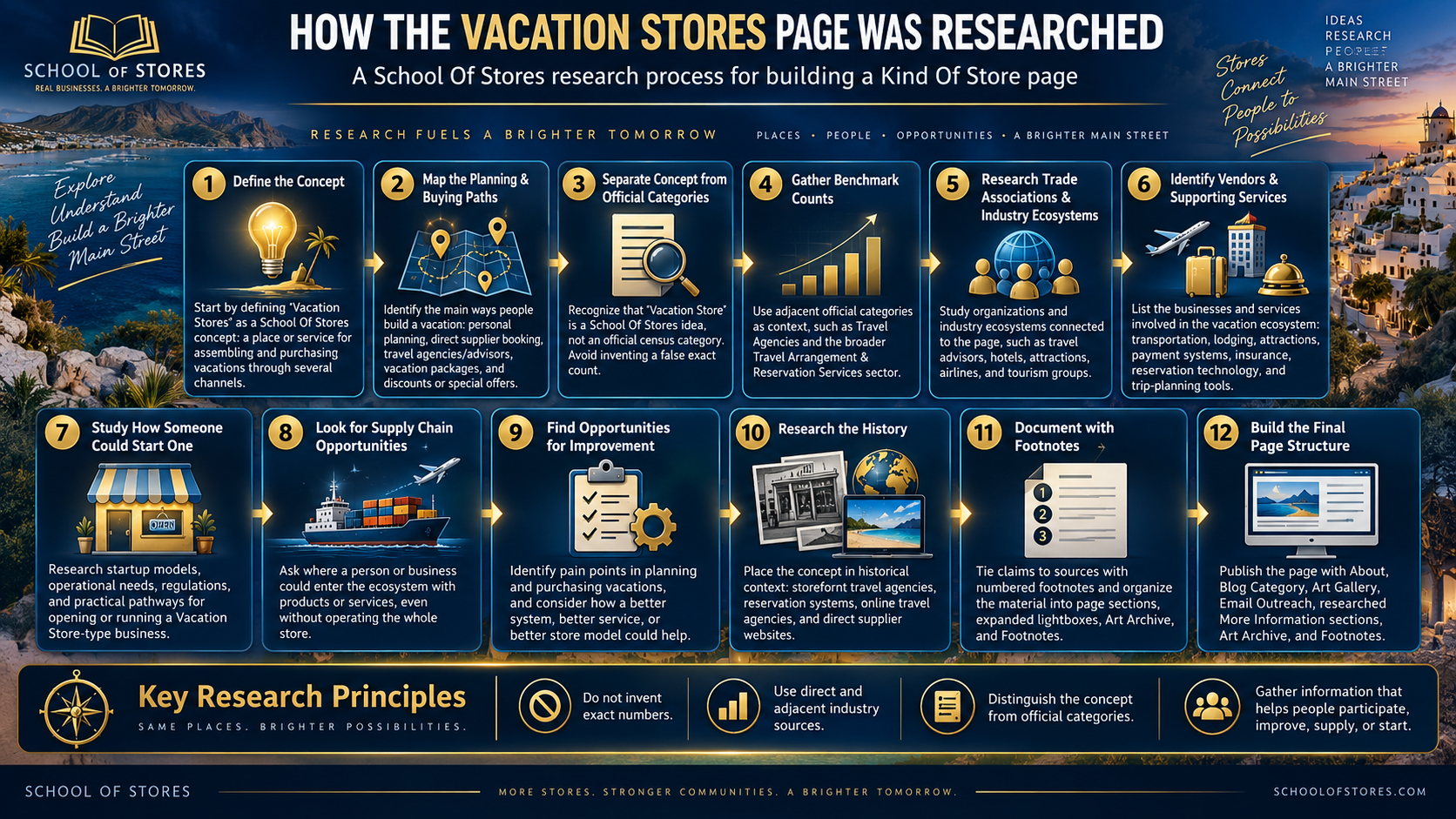
A Vacation Store helps people plan and purchase vacations by bringing together transportation, lodging, attractions, entertainment, and other trip components. School Of Stores uses the term broadly: a traveler might plan personally, purchase directly from an airline, hotel, cruise line, theme park, or other supplier, work with a travel agency or travel advisor, buy a package, pursue discounts and special offers, or combine several of those approaches.
ART GALLERY
The Latest Visuals
BLOG CATEGORY
Vacation Stores
Blog entries associated with Vacation Stores appear here automatically.
EMAIL OUTREACH
Reaching Out To The Travel Industry
School Of Stores can reach out to travel advisors, travel agencies, airlines, hotels and resorts, attractions, cruise lines, tour operators, booking-technology companies, destination organizations, and other travel suppliers to verify research, understand how vacations are assembled and sold, identify useful discounts or purchasing channels, and study where new products or services could improve vacation planning.
MORE INFORMATION
Personal Vacation Planning
A Vacation Store can begin with personal planning: deciding where and when to travel, identifying transportation, lodging, attractions, meals, local transportation, activities, and other needs, then comparing ways to purchase each component. The broader U.S. travel economy is large enough that travelers routinely interact with many separate suppliers while assembling one trip.[12]
MORE INFORMATION
Personal Vacation Planning
Footnotes
- U.S. Travel Association. U.S. Travel Forecast. May 7, 2026. Forecasts $1.37 trillion in total U.S. travel spending for 2026 and says domestic travel represents 87 percent of the total, illustrating the scale of the broader market surrounding Vacation Stores.
MORE INFORMATION
Purchasing Direct
Travelers can buy directly from the company providing a vacation component—for example an airline, hotel, cruise line, theme park, or other attraction. The U.S. Department of Transportation distinguishes direct airline purchases from travel-agency bookings, and supplier sites such as Walt Disney World directly sell lodging, admission, packages, and special offers.[3][4]
MORE INFORMATION
Purchasing Direct
Footnotes
- U.S. Department of Transportation. Buying a Ticket. Accessed September 18, 2026. Explains airfare comparison, optional-service costs, direct airline purchases versus travel-agency bookings, and how some consumer protections differ when tickets are booked through third parties.
- Walt Disney World Resort. Discover Disney World Vacation Packages. Accessed September 18, 2026. Shows a supplier-direct vacation-planning model in which a destination sells resort lodging, theme-park access, room-and-ticket packages, and time-limited special offers through its own website.
MORE INFORMATION
Travel Agencies & Travel Advisors
A traveler can also ask a travel agency or travel advisor to research, assemble, and book some or all of the trip. ASTA represents travel professionals and the traveling public, while IATAN recognizes multiple agency models including storefront, home-based, online, independent, host-agency, ticketing, and non-ticketing businesses.[5][7]
MORE INFORMATION
Travel Agencies & Travel Advisors
Footnotes
- American Society of Travel Advisors. American Society of Travel Advisors. Accessed September 18, 2026. ASTA describes itself as the leading association of travel professionals and says it advocates for travel agencies, the travel industry, and the traveling public.
- U.S. Department of Transportation. Buying a Ticket. Accessed September 18, 2026. Explains airfare comparison, optional-service costs, direct airline purchases versus travel-agency bookings, and how some consumer protections differ when tickets are booked through third parties.
- IATAN. Become Accredited. Accessed September 18, 2026. IATAN says more than 19,000 agencies are accredited and lists eligible business models including storefront, home-based, online, independent, host-agency, ticketing, and non-ticketing travel professionals.
MORE INFORMATION
Vacation Packages
Vacation packages combine multiple components into one purchasing path, such as lodging plus attraction tickets or other bundled travel services. Walt Disney World currently markets room-and-ticket vacation packages alongside individual hotel and admission products, showing how a destination itself can package multiple parts of a trip.[4]
MORE INFORMATION
Vacation Packages
Footnotes
- Walt Disney World Resort. Discover Disney World Vacation Packages. Accessed September 18, 2026. Shows a supplier-direct vacation-planning model in which a destination sells resort lodging, theme-park access, room-and-ticket packages, and time-limited special offers through its own website.
MORE INFORMATION
Discounts & Special Offers
Vacation discounts can come from direct supplier promotions, packages, memberships, event or convention rates, loyalty and credit-card programs, resident or group offers, and other limited eligibility channels. Current Disney offers and IAAPA Expo hotel arrangements show that discounts can be tied to dates, packages, residency, or event participation rather than representing one universally lowest price.[4][9]
MORE INFORMATION
Discounts & Special Offers
Footnotes
- Walt Disney World Resort. Discover Disney World Vacation Packages. Accessed September 18, 2026. Shows a supplier-direct vacation-planning model in which a destination sells resort lodging, theme-park access, room-and-ticket packages, and time-limited special offers through its own website.
- IAAPA. IAAPA Expo — On-Site Information. 2026 Expo information; accessed September 18, 2026. IAAPA Expo provides an adjacent attractions-industry marketplace and publishes official hotel accommodations and discounted rates for registered participants, illustrating event-linked travel offers and supplier overlap.
MORE INFORMATION
Number Of Vacation Stores
There is no official U.S. business category that exactly matches the School Of Stores definition of a Vacation Store, so an exact national count would be misleading. As adjacent benchmarks, the Census Bureau reports 9,308 employer travel-agency establishments and 15,704 employer establishments across the broader travel-arrangement and reservation-services industry group in 2023.[1][2]
MORE INFORMATION
Number Of Vacation Stores
Footnotes
- U.S. Census Bureau. 561510: Travel Agencies — Census Bureau Profile. 2023 County Business Patterns; accessed September 18, 2026. Defines travel agencies as establishments primarily acting as agents in selling travel, tour, and accommodation services and reports 9,308 U.S. employer establishments. This is an adjacent benchmark, not a count of the broader School Of Stores Vacation Store concept.
- U.S. Census Bureau. 5615: Travel Arrangement and Reservation Services — Census Bureau Profile. 2023 County Business Patterns; accessed September 18, 2026. Reports 15,704 U.S. employer establishments across the broader travel-arrangement and reservation-services industry group, which includes travel agencies, tour operators, and other reservation services.
MORE INFORMATION
Trade Associations & Industry Events
The Vacation Store ecosystem crosses several trade communities: ASTA directly represents travel professionals, while airlines, hotels, attractions, and other suppliers have their own associations and events. ASTA's Travel Advisor Conference, IAAPA Expo, and AHLA's Hospitality Show illustrate convention and trade-show environments where advisors, operators, suppliers, technology companies, and service providers can meet.[5][6][9][10][11][14]
MORE INFORMATION
Trade Associations & Industry Events
Footnotes
- American Society of Travel Advisors. American Society of Travel Advisors. Accessed September 18, 2026. ASTA describes itself as the leading association of travel professionals and says it advocates for travel agencies, the travel industry, and the traveling public.
- American Society of Travel Advisors. Travel Advisor Conference / Verified Travel Advisor Program. 2026 conference information; accessed September 18, 2026. ASTA promoted its 2026 Travel Advisor Conference for May 27–29 in San Diego and uses its advisor programs to connect travel professionals with education, suppliers, and industry opportunities.
- American Hotel & Lodging Association. About AHLA. Accessed September 18, 2026. AHLA describes itself as the largest U.S. hotel association representing the lodging ecosystem, including major brands, independent hotels, management companies, and industry partners and suppliers.
- Airlines for America. Who We Are. Accessed September 18, 2026. A4A identifies itself as the trade association for leading U.S. passenger and cargo airlines, making it an adjacent supplier-side association for the transportation component of vacation purchasing.
- IAAPA. IAAPA Expo — On-Site Information. 2026 Expo information; accessed September 18, 2026. IAAPA Expo provides an adjacent attractions-industry marketplace and publishes official hotel accommodations and discounted rates for registered participants, illustrating event-linked travel offers and supplier overlap.
- American Hotel & Lodging Association. The Hospitality Show Opens Registration for Industry Event Focused on Hotel Operations and Performance Optimization. June 3, 2026. Describes the November 2–4, 2026 Hospitality Show in Miami as an event bringing together hotel owners, operators, management companies, franchisees, and hospitality leaders, illustrating another adjacent convention-center ecosystem.
MORE INFORMATION
Vendors & Supporting Services
A Vacation Store depends on a wide vendor network: airlines and other transportation, hotels and resorts, attractions and ticketing, cruise lines and tour operators, booking and reservation technology, payment processing, travel insurance, maps and itinerary tools, local transportation, destination services, customer support, and professional accreditation or host-agency relationships.[7][10][11]
MORE INFORMATION
Vendors & Supporting Services
Footnotes
- IATAN. Become Accredited. Accessed September 18, 2026. IATAN says more than 19,000 agencies are accredited and lists eligible business models including storefront, home-based, online, independent, host-agency, ticketing, and non-ticketing travel professionals.
- American Hotel & Lodging Association. About AHLA. Accessed September 18, 2026. AHLA describes itself as the largest U.S. hotel association representing the lodging ecosystem, including major brands, independent hotels, management companies, and industry partners and suppliers.
- Airlines for America. Who We Are. Accessed September 18, 2026. A4A identifies itself as the trade association for leading U.S. passenger and cargo airlines, making it an adjacent supplier-side association for the transportation component of vacation purchasing.
MORE INFORMATION
Starting A Vacation Store
Starting a Vacation Store can range from a research-and-planning service to an accredited travel agency, online booking business, destination specialist, or physical storefront. The difficulty changes sharply depending on whether the business merely provides information or actually sells and arranges travel; accreditation, supplier relationships, payment handling, consumer disclosures, insurance, and seller-of-travel laws can become relevant.[7][8]
MORE INFORMATION
Starting A Vacation Store
Footnotes
- IATAN. Become Accredited. Accessed September 18, 2026. IATAN says more than 19,000 agencies are accredited and lists eligible business models including storefront, home-based, online, independent, host-agency, ticketing, and non-ticketing travel professionals.
- California Department of Justice, Office of the Attorney General. Seller of Travel. Accessed September 18, 2026. California requires sellers of travel doing business in the state to register and display their registration number in advertising. Requirements vary by jurisdiction, so this is an example of startup compliance rather than a universal U.S. rule.
MORE INFORMATION
Websites & Apps For Vacation Stores
A Vacation Store website or app can become a trip workspace rather than a static brochure: customers can save options, collaborate, compare, book, organize an itinerary, receive updates, and keep destination information together. Expedia's Trip Planner demonstrates collaborative saving and itinerary management in a current travel platform.[15]
MORE INFORMATION
Websites & Apps For Vacation Stores
Footnotes
- Expedia. Simplify your travel plans with Trip Planner. Accessed September 22, 2026. Current example of saving, comparing, collaborating on, booking, and managing trip options in a shared digital trip workspace.
MORE INFORMATION
Rewards & Equity Crowdfunds For Vacation Stores
Reward-based crowdfunding can test support for a destination guide, local information layer, printed/digital travel product, pilot concierge service, or other clearly bounded visitor-facing project, while an equity crowdfunding offering would involve selling securities rather than perks.[16][17]
MORE INFORMATION
Rewards & Equity Crowdfunds For Vacation Stores
Footnotes
- Kickstarter. How Crowdfunding Works: A Guide for Creators. September 2026. General reference for reward-based crowdfunding: backers can receive rewards, while Kickstarter does not provide equity or ownership to backers.
- U.S. Securities and Exchange Commission. Regulation Crowdfunding. Accessed September 22, 2026. Current federal overview: eligible issuers may raise up to $5 million in a 12-month period through an SEC-registered broker-dealer or funding portal, subject to disclosure and other requirements.
MORE INFORMATION
Supply Chain Opportunities
A person can enter the Vacation Store supply chain without becoming a travel agent: itinerary and booking software, destination research, accessibility planning, photography and video, hotel or attraction services, ground transportation, tours, event tickets, insurance, payment tools, loyalty and discount systems, customer support, data services, and specialized trip-planning products all sit somewhere between the traveler and the finished vacation.[9][10][11][12]
MORE INFORMATION
Supply Chain Opportunities
Footnotes
- IAAPA. IAAPA Expo — On-Site Information. 2026 Expo information; accessed September 18, 2026. IAAPA Expo provides an adjacent attractions-industry marketplace and publishes official hotel accommodations and discounted rates for registered participants, illustrating event-linked travel offers and supplier overlap.
- American Hotel & Lodging Association. About AHLA. Accessed September 18, 2026. AHLA describes itself as the largest U.S. hotel association representing the lodging ecosystem, including major brands, independent hotels, management companies, and industry partners and suppliers.
- Airlines for America. Who We Are. Accessed September 18, 2026. A4A identifies itself as the trade association for leading U.S. passenger and cargo airlines, making it an adjacent supplier-side association for the transportation component of vacation purchasing.
- American Hotel & Lodging Association. The Hospitality Show Opens Registration for Industry Event Focused on Hotel Operations and Performance Optimization. June 3, 2026. Describes the November 2–4, 2026 Hospitality Show in Miami as an event bringing together hotel owners, operators, management companies, franchisees, and hospitality leaders, illustrating another adjacent convention-center ecosystem.
MORE INFORMATION
Opportunities For Improvement
Vacation planning is often fragmented across transportation, lodging, attractions, reservation systems, maps, restaurants, discounts, policies, and support channels. A Vacation Store could improve the experience by making total trip cost, restrictions, direct-versus-intermediary purchasing, missing reservations, refund responsibilities, accessibility needs, and available offers easier to understand without pretending one booking method is always best.[3][4]
MORE INFORMATION
Opportunities For Improvement
Footnotes
- U.S. Department of Transportation. Buying a Ticket. Accessed September 18, 2026. Explains airfare comparison, optional-service costs, direct airline purchases versus travel-agency bookings, and how some consumer protections differ when tickets are booked through third parties.
- Walt Disney World Resort. Discover Disney World Vacation Packages. Accessed September 18, 2026. Shows a supplier-direct vacation-planning model in which a destination sells resort lodging, theme-park access, room-and-ticket packages, and time-limited special offers through its own website.
MORE INFORMATION
History Of Vacation Stores
The Vacation Store concept grows out of a long evolution from travel agents selling steamship and rail travel, through airline-era agencies and computerized reservation systems, to online travel agencies, supplier-direct websites, apps, loyalty programs, and today's mix of self-planning and professional advice. ASTA traces its own travel-agent history to 1931 and changed its name in 2018 to emphasize the modern advisor role.[13]
MORE INFORMATION
History Of Vacation Stores
Footnotes
- American Society of Travel Advisors. ASTA 2026 Press Kit — A Living History. 2026 press kit; accessed September 18, 2026. Traces ASTA to its 1931 founding as the American Steamship & Tourist Agents Association, its 1944 name change to American Society of Travel Agents, and its 2018 change to American Society of Travel Advisors as the industry shifted toward advisory services.
ART ARCHIVE
Visual Records

FOOTNOTES
Sources
- U.S. Census Bureau. 561510: Travel Agencies — Census Bureau Profile. 2023 County Business Patterns; accessed September 18, 2026. Defines travel agencies as establishments primarily acting as agents in selling travel, tour, and accommodation services and reports 9,308 U.S. employer establishments. This is an adjacent benchmark, not a count of the broader School Of Stores Vacation Store concept.
- U.S. Census Bureau. 5615: Travel Arrangement and Reservation Services — Census Bureau Profile. 2023 County Business Patterns; accessed September 18, 2026. Reports 15,704 U.S. employer establishments across the broader travel-arrangement and reservation-services industry group, which includes travel agencies, tour operators, and other reservation services.
- U.S. Department of Transportation. Buying a Ticket. Accessed September 18, 2026. Explains airfare comparison, optional-service costs, direct airline purchases versus travel-agency bookings, and how some consumer protections differ when tickets are booked through third parties.
- Walt Disney World Resort. Discover Disney World Vacation Packages. Accessed September 18, 2026. Shows a supplier-direct vacation-planning model in which a destination sells resort lodging, theme-park access, room-and-ticket packages, and time-limited special offers through its own website.
- American Society of Travel Advisors. American Society of Travel Advisors. Accessed September 18, 2026. ASTA describes itself as the leading association of travel professionals and says it advocates for travel agencies, the travel industry, and the traveling public.
- American Society of Travel Advisors. Travel Advisor Conference / Verified Travel Advisor Program. 2026 conference information; accessed September 18, 2026. ASTA promoted its 2026 Travel Advisor Conference for May 27–29 in San Diego and uses its advisor programs to connect travel professionals with education, suppliers, and industry opportunities.
- IATAN. Become Accredited. Accessed September 18, 2026. IATAN says more than 19,000 agencies are accredited and lists eligible business models including storefront, home-based, online, independent, host-agency, ticketing, and non-ticketing travel professionals.
- California Department of Justice, Office of the Attorney General. Seller of Travel. Accessed September 18, 2026. California requires sellers of travel doing business in the state to register and display their registration number in advertising. Requirements vary by jurisdiction, so this is an example of startup compliance rather than a universal U.S. rule.
- IAAPA. IAAPA Expo — On-Site Information. 2026 Expo information; accessed September 18, 2026. IAAPA Expo provides an adjacent attractions-industry marketplace and publishes official hotel accommodations and discounted rates for registered participants, illustrating event-linked travel offers and supplier overlap.
- American Hotel & Lodging Association. About AHLA. Accessed September 18, 2026. AHLA describes itself as the largest U.S. hotel association representing the lodging ecosystem, including major brands, independent hotels, management companies, and industry partners and suppliers.
- Airlines for America. Who We Are. Accessed September 18, 2026. A4A identifies itself as the trade association for leading U.S. passenger and cargo airlines, making it an adjacent supplier-side association for the transportation component of vacation purchasing.
- U.S. Travel Association. U.S. Travel Forecast. May 7, 2026. Forecasts $1.37 trillion in total U.S. travel spending for 2026 and says domestic travel represents 87 percent of the total, illustrating the scale of the broader market surrounding Vacation Stores.
- American Society of Travel Advisors. ASTA 2026 Press Kit — A Living History. 2026 press kit; accessed September 18, 2026. Traces ASTA to its 1931 founding as the American Steamship & Tourist Agents Association, its 1944 name change to American Society of Travel Agents, and its 2018 change to American Society of Travel Advisors as the industry shifted toward advisory services.
- American Hotel & Lodging Association. The Hospitality Show Opens Registration for Industry Event Focused on Hotel Operations and Performance Optimization. June 3, 2026. Describes the November 2–4, 2026 Hospitality Show in Miami as an event bringing together hotel owners, operators, management companies, franchisees, and hospitality leaders, illustrating another adjacent convention-center ecosystem.
- Expedia. Simplify your travel plans with Trip Planner. Accessed September 22, 2026. Current example of saving, comparing, collaborating on, booking, and managing trip options in a shared digital trip workspace.
- Kickstarter. How Crowdfunding Works: A Guide for Creators. September 2026. General reference for reward-based crowdfunding: backers can receive rewards, while Kickstarter does not provide equity or ownership to backers.
- U.S. Securities and Exchange Commission. Regulation Crowdfunding. Accessed September 22, 2026. Current federal overview: eligible issuers may raise up to $5 million in a 12-month period through an SEC-registered broker-dealer or funding portal, subject to disclosure and other requirements.