
ABOUT
Information
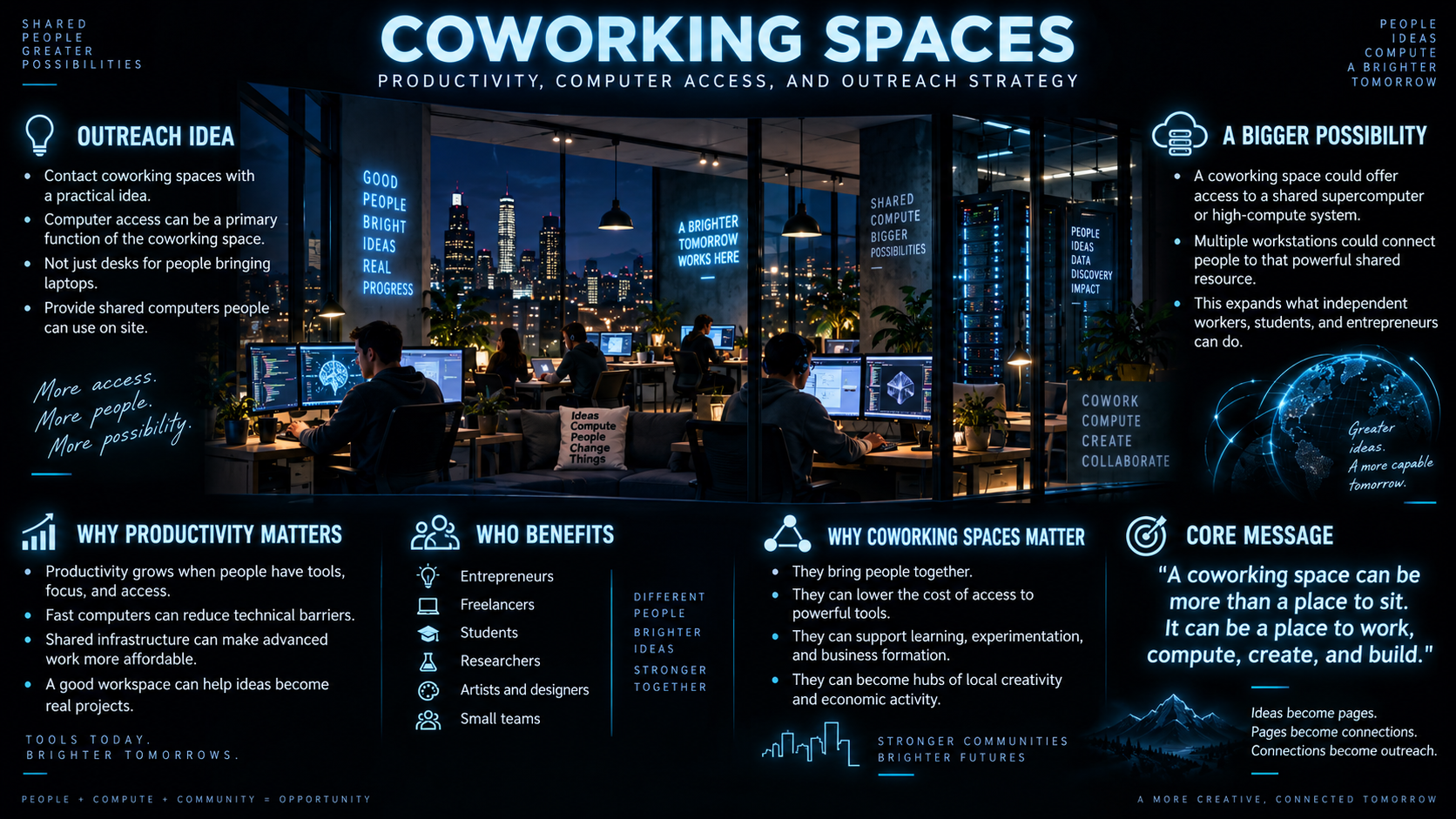
Coworking spaces are shared work environments. School Of Stores is especially interested in versions that make useful shared computing resources a primary part of the offering.
ART GALLERY
The Latest Visuals
BLOG CATEGORY
Coworking Spaces
Blog entries associated with Coworking Spaces appear here automatically.
Launchpads For A Brighter Tomorrow
September 23, 2026
Theme Park Merch Thoughts
September 17, 2026
EMAIL OUTREACH
Reaching Out To Coworking Spaces
School Of Stores can develop useful public information about coworking spaces first, then reach out to coworking-space operators to share the work, learn what they are doing, and explore ideas such as computers as a primary function and shared high-compute systems.
MORE INFORMATION
Computers As A Primary Function
School Of Stores is especially interested in coworking spaces where computers are available as a primary function of the business rather than simply providing desks for people who bring their own laptops. Because modern coworking operations already depend on management software, access systems, high-speed internet, and other shared technology, providing capable computers as part of the member experience is a plausible service direction even though it is not an industry-wide standard.[6]
MORE INFORMATION
Computers As A Primary Function
Footnotes
- Coworking Resources. Technology Roadmap for New Coworking Owners. Accessed September 18, 2026. Identifies coworking management software, access control, high-speed internet/Wi-Fi, and visitor management as core technology categories for coworking operations.
MORE INFORMATION
Shared High-Compute Systems
A more ambitious coworking model could provide shared high-compute systems or a powerful central computer accessed from multiple workstations, allowing members to use resources that would be expensive or impractical for each person to own individually. This is a School Of Stores development concept rather than a claim about standard coworking practice, and it would require careful planning around networking, software, security, scheduling, technical support, and utilization.[6]
MORE INFORMATION
Shared High-Compute Systems
Footnotes
- Coworking Resources. Technology Roadmap for New Coworking Owners. Accessed September 18, 2026. Identifies coworking management software, access control, high-speed internet/Wi-Fi, and visitor management as core technology categories for coworking operations.
MORE INFORMATION
Number Of Coworking Spaces
CoworkingCafe and Yardi’s monthly Coworking Index reported 9,523 U.S. coworking locations when accessed on September 18, 2026.[1] Its Q2 2026 industry report had recorded 9,384 locations in July, showing why School Of Stores treats the live index as a current market estimate rather than a permanent census figure.[2]
MORE INFORMATION
Number Of Coworking Spaces
Footnotes
- CoworkingCafe / Yardi. Coworking Index. Accessed September 18, 2026. The monthly U.S. index reported 9,523 coworking locations across more than 120 tracked markets. The index combines CoworkingCafe and Yardi Matrix data, so it is a market-tracking dataset rather than a government census.
- CoworkingCafe / Yardi. U.S. Coworking Industry Report Q2 ’26: Coworking Inventory Inching Towards 9,400, Adding Over 200 Locations. July 23, 2026. Reported 9,384 U.S. coworking locations in Q2 2026 and points readers to the monthly Coworking Index for current market counts.
MORE INFORMATION
Trade Associations & Industry Events
The Global Workspace Association directly serves the flexible-office and coworking industry and held its 2026 conference September 1–4 in Denver.[3][4] GCUC is another major industry ecosystem, describing itself as the world’s largest coworking conference series and bringing together workspace operators, service providers, landlords, developers, and other future-of-work participants.[5][10]
MORE INFORMATION
Trade Associations & Industry Events
Footnotes
- Global Workspace Association. About Us. Accessed September 18, 2026. Describes GWA as a global community and association serving the flexible office space industry, with a history of roughly 35 years.
- Global Workspace Association. 2026 GWA Conference. September 1–4, 2026. The Denver conference brought together flexible-office industry participants for networking, education, and coworking-space tours.
- GCUC. GCUC Community. Accessed September 18, 2026. GCUC describes itself as the world’s largest coworking conference series and says its events bring together workspace operators, service providers, and other future-of-work participants.
- GCUC. About GCUC. Accessed September 18, 2026. Describes GCUC’s origin as a dedicated coworking/flexible-workspace gathering and its growth into an international industry event series connecting operators, landlords, developers, and workplace professionals.
MORE INFORMATION
Vendors & Supporting Services
Coworking spaces depend on a broad vendor network that can include management software, access control, high-speed internet and Wi-Fi, visitor systems, furniture, conference-room and A/V equipment, printing, mail and package handling, coffee and kitchen supplies, cleaning, facility maintenance, IT support, staffing, and community-management services.[6][7][8] Some functions are handled in-house while others can be outsourced or supplied by specialists.
MORE INFORMATION
Vendors & Supporting Services
Footnotes
- Coworking Resources. Technology Roadmap for New Coworking Owners. Accessed September 18, 2026. Identifies coworking management software, access control, high-speed internet/Wi-Fi, and visitor management as core technology categories for coworking operations.
- Coworking Resources. Coworking Costs: A Breakdown by Stages. February 15, 2019. Lists setup and operating needs including rent, desks and chairs, insurance, routers and strong internet, utilities, pantry and cleaning supplies, management/access software, conference-room equipment, furniture, AV equipment, cabling, and staffing.
- Coworking Resources. Coworking Revenue Guide. Accessed September 18, 2026. Describes operating costs such as internet, telephones, access control, cleaning, electricity and utilities; recurring supplies such as coffee and office/kitchen items; facility costs; and staffing.
MORE INFORMATION
Starting A Coworking Space
Starting a coworking space combines commercial real estate with an operating-service business: the founder must evaluate rent or ownership costs, buildout, furniture, insurance, strong internet, utilities, access/security, management software, meeting-room equipment, supplies, staffing, and enough occupancy and revenue to carry recurring property and operating expenses.[7][8] Difficulty varies greatly by site, market, lease structure, and the services included.
MORE INFORMATION
Starting A Coworking Space
Footnotes
- Coworking Resources. Coworking Costs: A Breakdown by Stages. February 15, 2019. Lists setup and operating needs including rent, desks and chairs, insurance, routers and strong internet, utilities, pantry and cleaning supplies, management/access software, conference-room equipment, furniture, AV equipment, cabling, and staffing.
- Coworking Resources. Coworking Revenue Guide. Accessed September 18, 2026. Describes operating costs such as internet, telephones, access control, cleaning, electricity and utilities; recurring supplies such as coffee and office/kitchen items; facility costs; and staffing.
MORE INFORMATION
Supply Chain Opportunities
A person or business can enter the coworking supply chain without operating a coworking location: recurring opportunities exist in software, networking, access/security, furniture, AV, printing, mail services, coffee and supplies, cleaning, repairs, staffing and community operations, while buildouts and expansions create project-based demand for design, cabling, equipment, signage, and installation.[6][7][8] Industry conferences can help reveal which categories already have strong vendors and where gaps remain.[4][5]
MORE INFORMATION
Supply Chain Opportunities
Footnotes
- Coworking Resources. Technology Roadmap for New Coworking Owners. Accessed September 18, 2026. Identifies coworking management software, access control, high-speed internet/Wi-Fi, and visitor management as core technology categories for coworking operations.
- Coworking Resources. Coworking Costs: A Breakdown by Stages. February 15, 2019. Lists setup and operating needs including rent, desks and chairs, insurance, routers and strong internet, utilities, pantry and cleaning supplies, management/access software, conference-room equipment, furniture, AV equipment, cabling, and staffing.
- Coworking Resources. Coworking Revenue Guide. Accessed September 18, 2026. Describes operating costs such as internet, telephones, access control, cleaning, electricity and utilities; recurring supplies such as coffee and office/kitchen items; facility costs; and staffing.
- Global Workspace Association. 2026 GWA Conference. September 1–4, 2026. The Denver conference brought together flexible-office industry participants for networking, education, and coworking-space tours.
- GCUC. GCUC Community. Accessed September 18, 2026. GCUC describes itself as the world’s largest coworking conference series and says its events bring together workspace operators, service providers, and other future-of-work participants.
MORE INFORMATION
Opportunities For Improvement
Coworking improvements can target the recurring systems that shape the member experience and operating cost: internet reliability, access and visitor management, meeting-room technology, privacy and acoustics, space utilization, cleaning and maintenance, community management, and feedback from members.[6][7][8] School Of Stores also proposes exploring computers as a primary function and shared high-compute resources as differentiated services rather than assuming every member must supply all of their own computing equipment.
MORE INFORMATION
Opportunities For Improvement
Footnotes
- Coworking Resources. Technology Roadmap for New Coworking Owners. Accessed September 18, 2026. Identifies coworking management software, access control, high-speed internet/Wi-Fi, and visitor management as core technology categories for coworking operations.
- Coworking Resources. Coworking Costs: A Breakdown by Stages. February 15, 2019. Lists setup and operating needs including rent, desks and chairs, insurance, routers and strong internet, utilities, pantry and cleaning supplies, management/access software, conference-room equipment, furniture, AV equipment, cabling, and staffing.
- Coworking Resources. Coworking Revenue Guide. Accessed September 18, 2026. Describes operating costs such as internet, telephones, access control, cleaning, electricity and utilities; recurring supplies such as coffee and office/kitchen items; facility costs; and staffing.
MORE INFORMATION
Websites & Apps For Coworking Spaces
A coworking website or app can function as both storefront and operating interface: memberships, desk and room booking, payments, access, events, community communication, and account management can live in one connected system.[11]
MORE INFORMATION
Websites & Apps For Coworking Spaces
Footnotes
- Nexudus. Enhance your members digital experience with Nexudus apps. Accessed September 22, 2026. Current example of coworking member portals/apps for booking, buying memberships and services, payments, access, community activity, and operator management.
MORE INFORMATION
Rewards & Equity Crowdfunds For Coworking Spaces
Reward-based crowdfunding can test support for a new maker lab, podcast/video room, accessible workspace upgrade, community workshop series, or other clearly defined member-facing improvement, while an equity crowdfunding offering would involve selling securities rather than perks.[12][13]
MORE INFORMATION
Rewards & Equity Crowdfunds For Coworking Spaces
Footnotes
- Kickstarter. How Crowdfunding Works: A Guide for Creators. September 2026. General reference for reward-based crowdfunding: backers can receive rewards, while Kickstarter does not provide equity or ownership to backers.
- U.S. Securities and Exchange Commission. Regulation Crowdfunding. Accessed September 22, 2026. Current federal overview: eligible issuers may raise up to $5 million in a 12-month period through an SEC-registered broker-dealer or funding portal, subject to disclosure and other requirements.
MORE INFORMATION
History Of Coworking Spaces
Modern coworking is commonly traced to Brad Neuberg’s San Francisco Coworking Space at Spiral Muse in 2005, created to combine independent work with the structure and community of working alongside others.[9] Earlier shared-work and hackerspace models—including Berlin’s C-base and New York’s 42 West 24—are often treated as precursors, while later organizations and conference networks helped coworking grow into a broader flexible-workspace industry.[9][10]
MORE INFORMATION
History Of Coworking Spaces
Footnotes
- Coworking Resources. The History of Coworking. April 5, 2021. Traces modern coworking to Brad Neuberg’s San Francisco Coworking Space at Spiral Muse in 2005 while noting earlier precursors such as Berlin’s C-base and 42 West 24 in New York.
- GCUC. About GCUC. Accessed September 18, 2026. Describes GCUC’s origin as a dedicated coworking/flexible-workspace gathering and its growth into an international industry event series connecting operators, landlords, developers, and workplace professionals.
- Global Workspace Association. About Us. Accessed September 18, 2026. Describes GWA as a global community and association serving the flexible office space industry, with a history of roughly 35 years.
ART ARCHIVE
Visual Records

FOOTNOTES
Sources
- CoworkingCafe / Yardi. Coworking Index. Accessed September 18, 2026. The monthly U.S. index reported 9,523 coworking locations across more than 120 tracked markets. The index combines CoworkingCafe and Yardi Matrix data, so it is a market-tracking dataset rather than a government census.
- CoworkingCafe / Yardi. U.S. Coworking Industry Report Q2 ’26: Coworking Inventory Inching Towards 9,400, Adding Over 200 Locations. July 23, 2026. Reported 9,384 U.S. coworking locations in Q2 2026 and points readers to the monthly Coworking Index for current market counts.
- Global Workspace Association. About Us. Accessed September 18, 2026. Describes GWA as a global community and association serving the flexible office space industry, with a history of roughly 35 years.
- Global Workspace Association. 2026 GWA Conference. September 1–4, 2026. The Denver conference brought together flexible-office industry participants for networking, education, and coworking-space tours.
- GCUC. GCUC Community. Accessed September 18, 2026. GCUC describes itself as the world’s largest coworking conference series and says its events bring together workspace operators, service providers, and other future-of-work participants.
- Coworking Resources. Technology Roadmap for New Coworking Owners. Accessed September 18, 2026. Identifies coworking management software, access control, high-speed internet/Wi-Fi, and visitor management as core technology categories for coworking operations.
- Coworking Resources. Coworking Costs: A Breakdown by Stages. February 15, 2019. Lists setup and operating needs including rent, desks and chairs, insurance, routers and strong internet, utilities, pantry and cleaning supplies, management/access software, conference-room equipment, furniture, AV equipment, cabling, and staffing.
- Coworking Resources. Coworking Revenue Guide. Accessed September 18, 2026. Describes operating costs such as internet, telephones, access control, cleaning, electricity and utilities; recurring supplies such as coffee and office/kitchen items; facility costs; and staffing.
- Coworking Resources. The History of Coworking. April 5, 2021. Traces modern coworking to Brad Neuberg’s San Francisco Coworking Space at Spiral Muse in 2005 while noting earlier precursors such as Berlin’s C-base and 42 West 24 in New York.
- GCUC. About GCUC. Accessed September 18, 2026. Describes GCUC’s origin as a dedicated coworking/flexible-workspace gathering and its growth into an international industry event series connecting operators, landlords, developers, and workplace professionals.
- Nexudus. Enhance your members digital experience with Nexudus apps. Accessed September 22, 2026. Current example of coworking member portals/apps for booking, buying memberships and services, payments, access, community activity, and operator management.
- Kickstarter. How Crowdfunding Works: A Guide for Creators. September 2026. General reference for reward-based crowdfunding: backers can receive rewards, while Kickstarter does not provide equity or ownership to backers.
- U.S. Securities and Exchange Commission. Regulation Crowdfunding. Accessed September 22, 2026. Current federal overview: eligible issuers may raise up to $5 million in a 12-month period through an SEC-registered broker-dealer or funding portal, subject to disclosure and other requirements.