ABOUT
Information
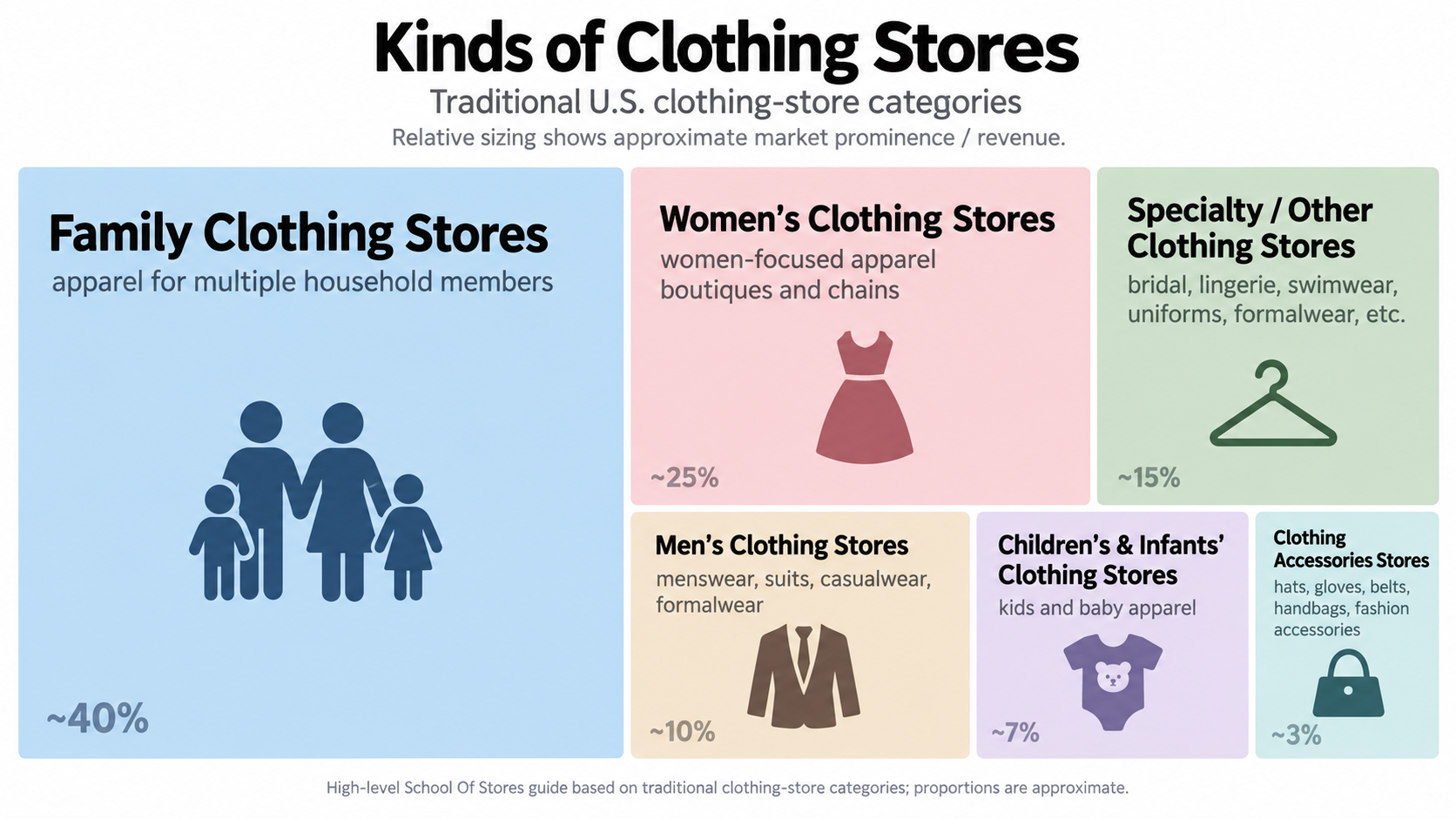
Clothing stores sell general or specialized lines of apparel and clothing accessories through physical stores, online storefronts, or combinations of both. School Of Stores treats Clothing Stores as a broad parent Kind Of Store that can later contain more-specific clothing-store types, each with its own structured record, page, research, and nested Current category.
ART GALLERY
The Latest Visuals
BLOG CATEGORY
Clothing Stores
Blog entries associated with Clothing Stores appear here automatically.
KIND OF CLOTHING STORE
Online-Only T-Shirt Stores
KIND OF CLOTHING STORE
Swimwear Stores
EMAIL OUTREACH
Reaching Out To Clothing Stores
School Of Stores can reach out to independent clothing stores, apparel retailers, brands, wholesalers, manufacturers, trade groups, retail-technology companies, designers, alteration specialists, logistics providers, and other vendors to verify research, learn recurring operating needs, and identify practical ways people could start, supply, service, or improve clothing stores.
MORE INFORMATION
Number Of Clothing Stores
There is no single live count that perfectly matches the everyday phrase “clothing store.” As a useful benchmark, the U.S. Census Bureau's 2022 Economic Census reports 41,966 firms in NAICS 458110, Clothing and Clothing Accessories Retailers; that category should be read with its formal scope and exclusions in mind.[1][2]
MORE INFORMATION
Number Of Clothing Stores
Footnotes
- U.S. Census Bureau. 2022 Economic Census — Clothing and Clothing Accessories Retailers (NAICS 458110). 2022 reference year; accessed September 18, 2026. The Economic Census reports 41,966 firms for NAICS 458110. This is a dated industry benchmark, not a live count of individual storefronts, and the Census category has boundaries that differ from the broader everyday phrase “clothing store.”
- U.S. Census Bureau. 2022 NAICS Manual — 458110 Clothing and Clothing Accessories Retailers. 2022 NAICS. Defines 458110 as retailers of general or specialized lines of new clothing and clothing accessories and notes cross-references for shoes, used clothing, custom apparel made on premises, and other adjacent categories.
MORE INFORMATION
Trade Associations & Industry Events
Clothing retailers sit inside both the apparel supply chain and the broader retail industry. AAFA directly represents apparel, footwear, brands, retailers, manufacturers, and suppliers, while NRF provides a wider retail ecosystem whose major events bring retailers together with technology and service vendors.[3][4][5]
MORE INFORMATION
Trade Associations & Industry Events
Footnotes
- American Apparel & Footwear Association. About AAFA / Who We Are. Accessed September 18, 2026. AAFA describes itself as the national trade association representing apparel, footwear, sewn-product companies, retailers, manufacturers, and suppliers across the industry supply chain.
- National Retail Federation. About NRF. Accessed September 18, 2026. NRF represents the broader retail industry and provides advocacy, education, research, networking, and industry events relevant to apparel retailers as part of the larger retail ecosystem.
- National Retail Federation. NRF 2027: Retail's Big Show Overview. 2027 event information; accessed September 18, 2026. NRF describes Retail's Big Show as bringing more than 41,000 retail professionals together with 1,000+ industry partners, technology and service providers, education, demonstrations, and networking.
MORE INFORMATION
Vendors & Supporting Services
A clothing store depends on a broad vendor network: apparel brands and manufacturers, wholesalers, textile and trim suppliers, freight and fulfillment, fixtures, mannequins, hangers, alteration services, POS and inventory systems, e-commerce, payments, photography, marketing, security, cleaning, accounting, insurance, and other store services.[3][8]
MORE INFORMATION
Vendors & Supporting Services
Footnotes
- American Apparel & Footwear Association. About AAFA / Who We Are. Accessed September 18, 2026. AAFA describes itself as the national trade association representing apparel, footwear, sewn-product companies, retailers, manufacturers, and suppliers across the industry supply chain.
- Square. Clothing Store POS and Apparel Inventory Management. Accessed September 18, 2026. Illustrates the technology/service ecosystem around clothing retail: payments, inventory, purchase orders, returns and exchanges, customer profiles, online selling, pickup, loyalty, marketing, and store hardware.
MORE INFORMATION
Starting A Clothing Store
Starting a clothing store requires decisions about customer niche, merchandise and sourcing, sales channels, location or online model, inventory investment, pricing and margins, store fixtures, POS/e-commerce systems, staffing, marketing, business registration, permits, insurance, and working capital.[6][7][8]
MORE INFORMATION
Starting A Clothing Store
Footnotes
- U.S. Small Business Administration. Plan Your Business / Estimate Startup Costs. Accessed September 18, 2026. SBA startup planning guidance identifies expenses such as space, equipment, utilities, licenses and permits, insurance, professional services, inventory, wages, marketing, market research, and websites.
- U.S. Small Business Administration. Launch Your Business. Accessed September 18, 2026. SBA launch guidance covers location, business structure, registration, tax IDs, licenses and permits, bank accounts, and business insurance.
- Square. Clothing Store POS and Apparel Inventory Management. Accessed September 18, 2026. Illustrates the technology/service ecosystem around clothing retail: payments, inventory, purchase orders, returns and exchanges, customer profiles, online selling, pickup, loyalty, marketing, and store hardware.
MORE INFORMATION
Websites & Apps For Clothing Stores
A Clothing Store website or app works best when online and physical inventory behave as one system: sizes, colors, stock, orders, pickup, returns, customer profiles, loyalty, and product presentation should stay synchronized. Shopify POS explicitly markets this connected online/in-store model to clothing, shoe, and accessory stores.[11]
MORE INFORMATION
Websites & Apps For Clothing Stores
Footnotes
- Shopify. Connect in-store and online sales with Shopify POS — Clothing, shoe, and accessory stores. Accessed September 22, 2026. Current apparel-retail example of synchronized online/in-store inventory and orders, pickup, and customer-facing omnichannel tools.
MORE INFORMATION
Rewards & Equity Crowdfunds For Clothing Stores
Reward-based crowdfunding can test support for a limited collection, locally produced capsule line, fashion-show/catalog project, alteration-service launch, or another clearly defined apparel release, while an equity crowdfunding offering would involve selling securities rather than perks.[12][13]
MORE INFORMATION
Rewards & Equity Crowdfunds For Clothing Stores
Footnotes
- Kickstarter. How Crowdfunding Works: A Guide for Creators. September 2026. General reference for reward-based crowdfunding: backers can receive rewards, while Kickstarter does not provide equity or ownership to backers.
- U.S. Securities and Exchange Commission. Regulation Crowdfunding. Accessed September 22, 2026. Current federal overview: eligible issuers may raise up to $5 million in a 12-month period through an SEC-registered broker-dealer or funding portal, subject to disclosure and other requirements.
MORE INFORMATION
Supply Chain Opportunities
A person does not have to open a clothing store to participate in the industry. Opportunities exist in design, private-label production, manufacturing, wholesale, textile and trim supply, logistics, alterations, fixtures, retail technology, photography, modeling, e-commerce, marketing, repair, returns, resale, and professional services.[3][8]
MORE INFORMATION
Supply Chain Opportunities
Footnotes
- American Apparel & Footwear Association. About AAFA / Who We Are. Accessed September 18, 2026. AAFA describes itself as the national trade association representing apparel, footwear, sewn-product companies, retailers, manufacturers, and suppliers across the industry supply chain.
- Square. Clothing Store POS and Apparel Inventory Management. Accessed September 18, 2026. Illustrates the technology/service ecosystem around clothing retail: payments, inventory, purchase orders, returns and exchanges, customer profiles, online selling, pickup, loyalty, marketing, and store hardware.
MORE INFORMATION
Opportunities For Improvement
Clothing stores can look for improvements in sizing and fit, inventory accuracy, returns, product discovery, fitting rooms, accessibility, omnichannel stock visibility, personalization, local or private-label products, product information, repair and alteration services, resale, sustainability, and the connection between physical and online shopping.[5][8]
MORE INFORMATION
Opportunities For Improvement
Footnotes
- Square. Clothing Store POS and Apparel Inventory Management. Accessed September 18, 2026. Illustrates the technology/service ecosystem around clothing retail: payments, inventory, purchase orders, returns and exchanges, customer profiles, online selling, pickup, loyalty, marketing, and store hardware.
- National Retail Federation. NRF 2027: Retail's Big Show Overview. 2027 event information; accessed September 18, 2026. NRF describes Retail's Big Show as bringing more than 41,000 retail professionals together with 1,000+ industry partners, technology and service providers, education, demonstrations, and networking.
MORE INFORMATION
History Of Clothing Stores
Modern clothing retail grew alongside ready-to-wear manufacturing, department stores, catalogs, and later specialty chains and online commerce. Smithsonian research notes that by the 1890s Americans could buy mass-produced off-the-rack clothing in department stores and mail-order catalogs, a major shift from earlier made-to-measure and home production.[9][10]
MORE INFORMATION
History Of Clothing Stores
Footnotes
- Library of Congress. Fashion Industry: A Resource Guide — Historical Resources. Updated 2026; accessed September 18, 2026. Provides historical context for merchant tailors, dressmakers, dry-goods stores, ready-to-wear, department stores, fashion businesses, and the growth of the U.S. apparel industry.
- National Museum of American History. Ready-to-Wear Clothes = Opportunity. Historical exhibit; accessed September 18, 2026. Explains that by the 1890s men and women could buy mass-produced off-the-rack clothing in department stores and mail-order catalogs, helping establish modern ready-to-wear retail.
ART ARCHIVE
Visual Records

FOOTNOTES
Sources
- U.S. Census Bureau. 2022 Economic Census — Clothing and Clothing Accessories Retailers (NAICS 458110). 2022 reference year; accessed September 18, 2026. The Economic Census reports 41,966 firms for NAICS 458110. This is a dated industry benchmark, not a live count of individual storefronts, and the Census category has boundaries that differ from the broader everyday phrase “clothing store.”
- U.S. Census Bureau. 2022 NAICS Manual — 458110 Clothing and Clothing Accessories Retailers. 2022 NAICS. Defines 458110 as retailers of general or specialized lines of new clothing and clothing accessories and notes cross-references for shoes, used clothing, custom apparel made on premises, and other adjacent categories.
- American Apparel & Footwear Association. About AAFA / Who We Are. Accessed September 18, 2026. AAFA describes itself as the national trade association representing apparel, footwear, sewn-product companies, retailers, manufacturers, and suppliers across the industry supply chain.
- National Retail Federation. About NRF. Accessed September 18, 2026. NRF represents the broader retail industry and provides advocacy, education, research, networking, and industry events relevant to apparel retailers as part of the larger retail ecosystem.
- National Retail Federation. NRF 2027: Retail's Big Show Overview. 2027 event information; accessed September 18, 2026. NRF describes Retail's Big Show as bringing more than 41,000 retail professionals together with 1,000+ industry partners, technology and service providers, education, demonstrations, and networking.
- U.S. Small Business Administration. Plan Your Business / Estimate Startup Costs. Accessed September 18, 2026. SBA startup planning guidance identifies expenses such as space, equipment, utilities, licenses and permits, insurance, professional services, inventory, wages, marketing, market research, and websites.
- U.S. Small Business Administration. Launch Your Business. Accessed September 18, 2026. SBA launch guidance covers location, business structure, registration, tax IDs, licenses and permits, bank accounts, and business insurance.
- Square. Clothing Store POS and Apparel Inventory Management. Accessed September 18, 2026. Illustrates the technology/service ecosystem around clothing retail: payments, inventory, purchase orders, returns and exchanges, customer profiles, online selling, pickup, loyalty, marketing, and store hardware.
- National Museum of American History. Ready-to-Wear Clothes = Opportunity. Historical exhibit; accessed September 18, 2026. Explains that by the 1890s men and women could buy mass-produced off-the-rack clothing in department stores and mail-order catalogs, helping establish modern ready-to-wear retail.
- Library of Congress. Fashion Industry: A Resource Guide — Historical Resources. Updated 2026; accessed September 18, 2026. Provides historical context for merchant tailors, dressmakers, dry-goods stores, ready-to-wear, department stores, fashion businesses, and the growth of the U.S. apparel industry.
- Shopify. Connect in-store and online sales with Shopify POS — Clothing, shoe, and accessory stores. Accessed September 22, 2026. Current apparel-retail example of synchronized online/in-store inventory and orders, pickup, and customer-facing omnichannel tools.
- Kickstarter. How Crowdfunding Works: A Guide for Creators. September 2026. General reference for reward-based crowdfunding: backers can receive rewards, while Kickstarter does not provide equity or ownership to backers.
- U.S. Securities and Exchange Commission. Regulation Crowdfunding. Accessed September 22, 2026. Current federal overview: eligible issuers may raise up to $5 million in a 12-month period through an SEC-registered broker-dealer or funding portal, subject to disclosure and other requirements.