ABOUT
Information
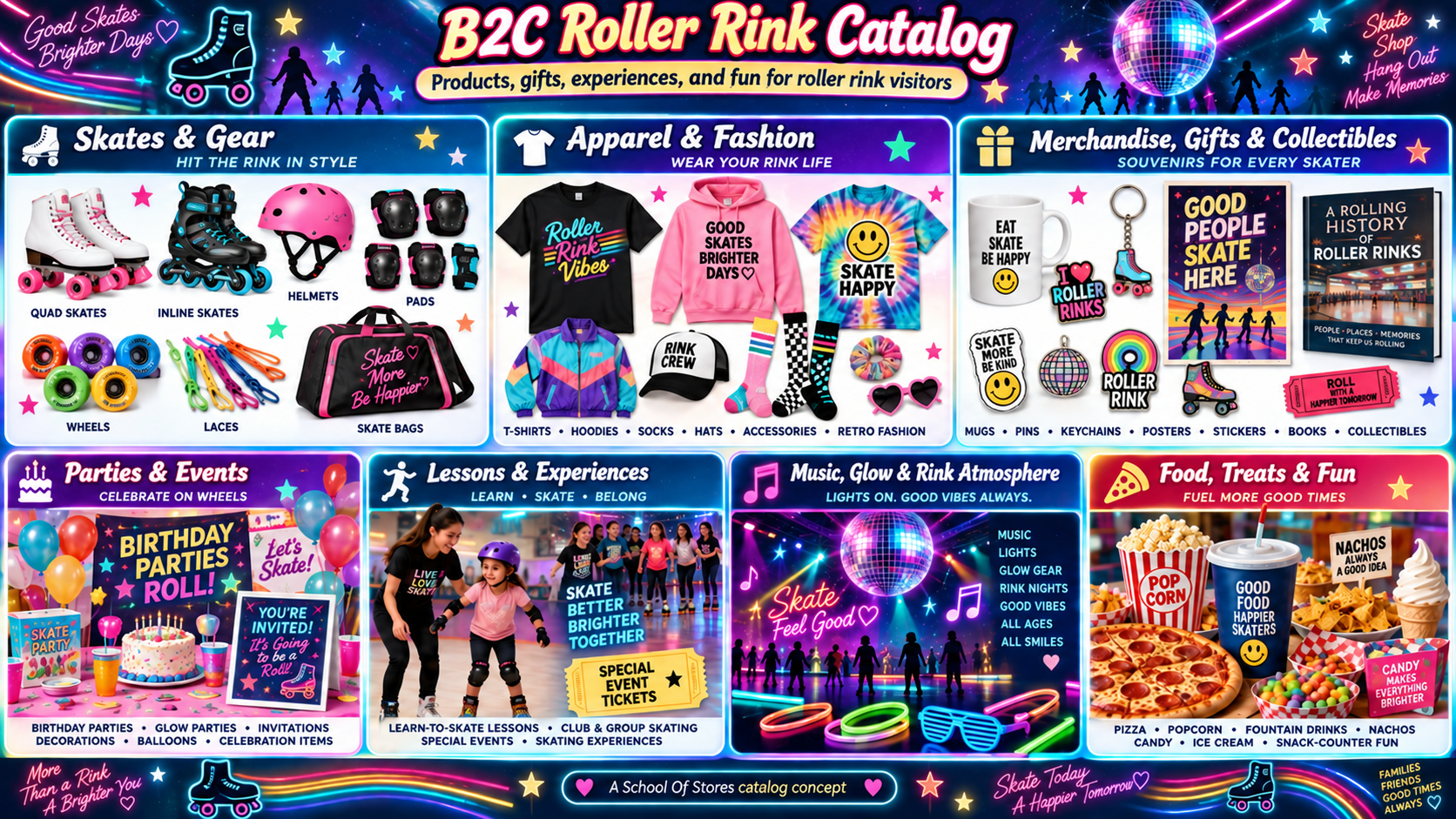
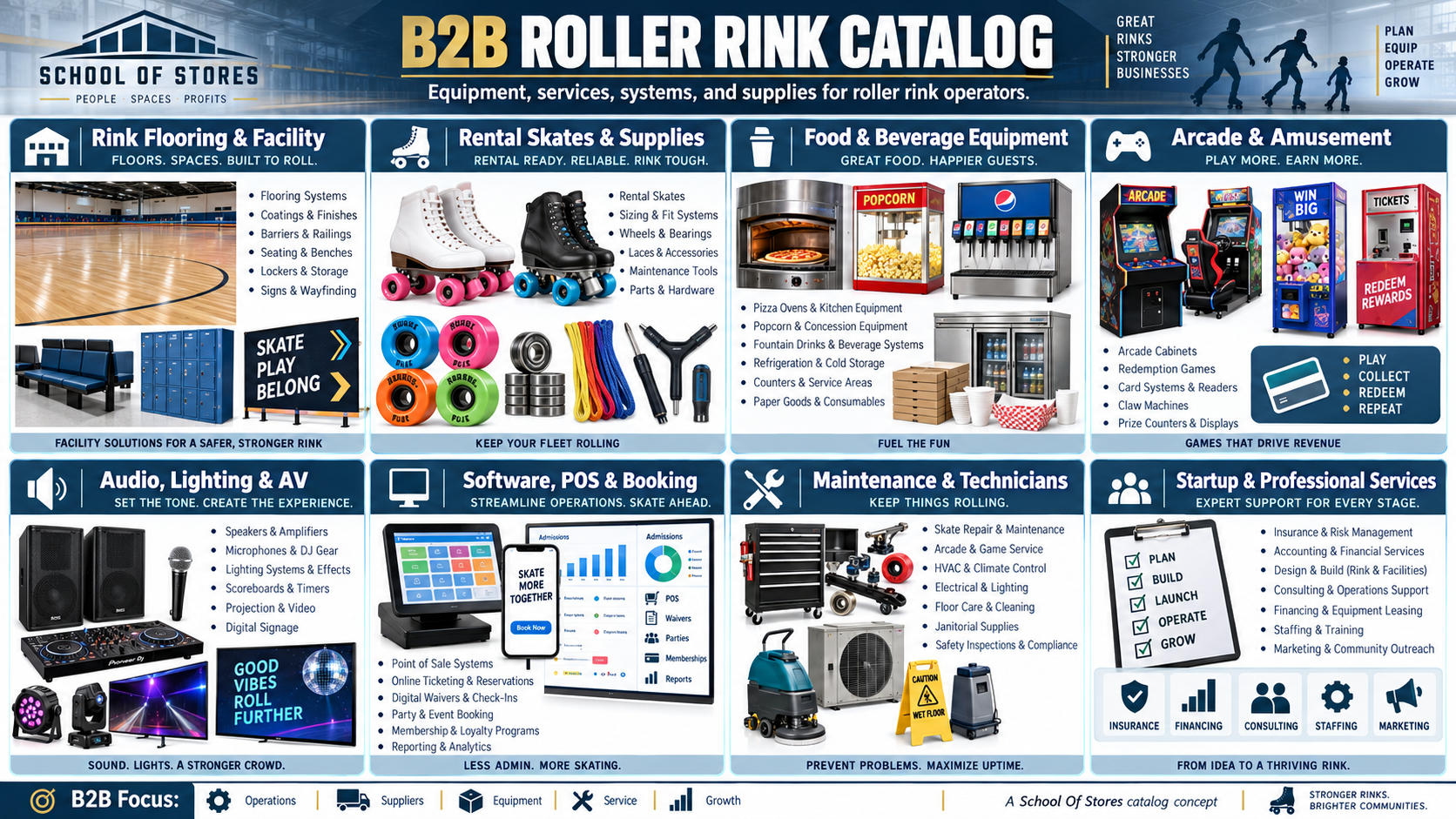
Roller rinks are skating-centered entertainment businesses built around a purpose-designed skating floor and the services that make repeated public sessions, parties, lessons, events, food, games, and other activities possible. School Of Stores is studying the full business ecosystem around rinks so people can consider operating one, supplying one, servicing one, or proposing useful improvements.
ART GALLERY
The Latest Visuals
BLOG CATEGORY
Roller Rinks
Blog entries associated with Roller Rinks appear here automatically.
EMAIL OUTREACH
Reaching Out To Roller Rinks
School Of Stores can reach out to roller-rink owners and operators to learn how their businesses work, verify research, identify recurring needs, and understand where independent service providers, suppliers, technicians, creators, and prospective operators could contribute useful products, services, or ideas.
MORE INFORMATION
Number Of Roller Rinks
The Roller Skating Association estimated about 1,125 roller rinks in the United States in August 2025, down from about 1,250 before the pandemic and more than 2,000 in the 1980s.[1] Because this is an industry estimate rather than a continuously updated national census, School Of Stores treats 1,125 as a useful baseline rather than an exact live count.
MORE INFORMATION
Number Of Roller Rinks
Footnotes
- The Atlanta Journal-Constitution. Gwinnett skating rink Skate Along USA to close after 47 years. August 2025. Reports Roller Skating Association estimates of about 1,125 U.S. rinks, about 1,250 before the pandemic, and more than 2,000 in the 1980s. This is an industry-association estimate rather than a real-time national census.
MORE INFORMATION
Trade Associations & Industry Events
Roller rinks have a direct trade association in the Roller Skating Association International, which dates its predecessor organization to 1937 and runs an industry convention and trade show.[2][3] Rinks also overlap with the broader family-entertainment and attractions ecosystem represented at IAAPA Expo, while arcade-heavy operations can overlap with AAMA/AMOA and Amusement Expo International.[4][8]
MORE INFORMATION
Trade Associations & Industry Events
Footnotes
- Roller Skating Association International. About the Roller Skating Association. Accessed September 18, 2026. Identifies RSA as the industry trade association, traces the organization to 1937, and describes its membership of rink operators, instructors, manufacturers, and suppliers.
- Roller Skating Association International. Convention & Trade Show. 2026 event information. Describes the RSA convention and trade show for current and future rink owners and the suppliers seeking to meet roller-skating-industry decision-makers.
- IAAPA. IAAPA Expo — Exhibitors and Pavilions. 2026 Expo information. Shows the adjacent attractions/FEC marketplace, including Family Entertainment, Food & Beverages, Games & Arcade, Operational Services, merchandise, technology, and other supplier categories.
- Amusement Expo International. Amusement Expo International 2026. March 16–19, 2026 event information. The AAMA/AMOA-sponsored event serves the amusement and family-entertainment industry and provides an adjacent venue for arcade, amusement, vending, and related suppliers.
MORE INFORMATION
Vendors & Supporting Services
A roller rink can depend on far more than skates and a floor: the RSA supplier ecosystem includes flooring and installation, concessions, technology, arcade-related services, consulting and planning, finance, insurance, and other operating support.[5][6] Individual rinks may therefore create opportunities for food-and-beverage vendors, amusement suppliers, repair technicians, software providers, facility contractors, and other specialists.
MORE INFORMATION
Vendors & Supporting Services
Footnotes
- Roller Skating Association International. Membership — Supplier (RSM) Membership. Accessed September 18, 2026. RSA says its supplier members provide services directly to skating centers in areas including technology, flooring, concessions, skate manufacturing, finance, insurance, and more.
- Roller Skating Association International. Find a Supplier. Accessed September 18, 2026. The RSA supplier directory includes categories such as arcade, bar, concessions, consulting and rink planning, computer technology, flooring/materials/installations, and other rink services.
MORE INFORMATION
Starting A Roller Rink
Starting a roller rink is a comparatively demanding physical-location business because it combines financing, a large suitable site, zoning and parking, life-safety and accessibility requirements, a specialized floor, insurance, music licensing, equipment, staffing, and often food or amusement operations.[7] Existing facilities or conversions may remove some barriers, but every location still requires local feasibility and code research.
MORE INFORMATION
Starting A Roller Rink
Footnotes
- Roller Skating Association International. 10 Things You Need to Know When Opening Your Own Skating Rink. October 9, 2025. RSA startup guidance covers financing, feasibility, site selection, zoning, parking, life safety, accessibility, skating floors, music licensing, insurance, revenue diversification, permitting, and operating procedures.
MORE INFORMATION
Websites & Apps For Roller Rinks
A roller-rink website or app can combine public session schedules, ticketing, party bookings, lessons, waivers, rentals, memberships, concessions, loyalty, and event communication. Venue platforms such as ROLLER show how bookings, payments, online checkout, POS, staff permissions, and performance reporting can be managed together.[11]
MORE INFORMATION
Websites & Apps For Roller Rinks
Footnotes
- ROLLER. Find your way around Venue Manager. August 12, 2026. Current venue-management example covering product catalogs, bookings, payments, online checkout, POS menus, staff access, and performance.
MORE INFORMATION
Rewards & Equity Crowdfunds For Roller Rinks
Reward-based crowdfunding can test support for a floor resurfacing project, new lighting/sound experience, beginner-skating program, accessible improvements, or a defined community-event series, while an equity crowdfunding offering would involve selling securities rather than perks.[12][13]
MORE INFORMATION
Rewards & Equity Crowdfunds For Roller Rinks
Footnotes
- Kickstarter. How Crowdfunding Works: A Guide for Creators. September 2026. General reference for reward-based crowdfunding: backers can receive rewards, while Kickstarter does not provide equity or ownership to backers.
- U.S. Securities and Exchange Commission. Regulation Crowdfunding. Accessed September 22, 2026. Current federal overview: eligible issuers may raise up to $5 million in a 12-month period through an SEC-registered broker-dealer or funding portal, subject to disclosure and other requirements.
MORE INFORMATION
Supply Chain Opportunities
The roller-rink supply chain includes specialized skating products as well as ordinary business categories adapted to rink use: floors, skates and parts, concessions, arcade equipment, technology, insurance, finance, planning, maintenance, event products, and operational services.[5][6] Trade shows such as the RSA convention, IAAPA Expo, and Amusement Expo provide practical places to study who already sells into these channels and where gaps may remain.[3][4][8]
MORE INFORMATION
Supply Chain Opportunities
Footnotes
- Roller Skating Association International. Membership — Supplier (RSM) Membership. Accessed September 18, 2026. RSA says its supplier members provide services directly to skating centers in areas including technology, flooring, concessions, skate manufacturing, finance, insurance, and more.
- Roller Skating Association International. Find a Supplier. Accessed September 18, 2026. The RSA supplier directory includes categories such as arcade, bar, concessions, consulting and rink planning, computer technology, flooring/materials/installations, and other rink services.
- Roller Skating Association International. Convention & Trade Show. 2026 event information. Describes the RSA convention and trade show for current and future rink owners and the suppliers seeking to meet roller-skating-industry decision-makers.
- IAAPA. IAAPA Expo — Exhibitors and Pavilions. 2026 Expo information. Shows the adjacent attractions/FEC marketplace, including Family Entertainment, Food & Beverages, Games & Arcade, Operational Services, merchandise, technology, and other supplier categories.
- Amusement Expo International. Amusement Expo International 2026. March 16–19, 2026 event information. The AAMA/AMOA-sponsored event serves the amusement and family-entertainment industry and provides an adjacent venue for arcade, amusement, vending, and related suppliers.
MORE INFORMATION
Opportunities For Improvement
Potential improvements can come from studying recurring friction for guests and operators: booking and payment, food service, arcade uptime, skate and floor maintenance, staffing, safety, accessibility, parties and group sales, sound and lighting, marketing, and the use of technology and data.[4][7] School Of Stores can use those observations to frame suggestions without assuming every rink has the same problems or priorities.
MORE INFORMATION
Opportunities For Improvement
Footnotes
- IAAPA. IAAPA Expo — Exhibitors and Pavilions. 2026 Expo information. Shows the adjacent attractions/FEC marketplace, including Family Entertainment, Food & Beverages, Games & Arcade, Operational Services, merchandise, technology, and other supplier categories.
- Roller Skating Association International. 10 Things You Need to Know When Opening Your Own Skating Rink. October 9, 2025. RSA startup guidance covers financing, feasibility, site selection, zoning, parking, life safety, accessibility, skating floors, music licensing, insurance, revenue diversification, permitting, and operating procedures.
MORE INFORMATION
History Of Roller Rinks
Modern roller-rink history is tied to major changes in skate technology and repeated waves of social popularity: James Leonard Plimpton patented a four-wheel turning skate in 1863, organized rink culture later developed into a formal trade association founded in 1937, and roller skating has risen and fallen in popularity many times since.[9][2][10] The present U.S. rink count is substantially below the level reported for the 1980s.[1]
MORE INFORMATION
History Of Roller Rinks
Footnotes
- National Museum of Roller Skating. The Father of Modern Roller Skating. Accessed September 18, 2026. Documents James Leonard Plimpton's January 1863 patent for a four-wheel turning roller skate, an important technical step toward modern rink skating.
- Roller Skating Association International. About the Roller Skating Association. Accessed September 18, 2026. Identifies RSA as the industry trade association, traces the organization to 1937, and describes its membership of rink operators, instructors, manufacturers, and suppliers.
- National Museum of Roller Skating. Skating in the 20th Century and Beyond. Accessed September 18, 2026. Describes repeated rises and declines in roller skating popularity across the twentieth century and into the present.
- The Atlanta Journal-Constitution. Gwinnett skating rink Skate Along USA to close after 47 years. August 2025. Reports Roller Skating Association estimates of about 1,125 U.S. rinks, about 1,250 before the pandemic, and more than 2,000 in the 1980s. This is an industry-association estimate rather than a real-time national census.
ART ARCHIVE
Visual Records

FOOTNOTES
Sources
- The Atlanta Journal-Constitution. Gwinnett skating rink Skate Along USA to close after 47 years. August 2025. Reports Roller Skating Association estimates of about 1,125 U.S. rinks, about 1,250 before the pandemic, and more than 2,000 in the 1980s. This is an industry-association estimate rather than a real-time national census.
- Roller Skating Association International. About the Roller Skating Association. Accessed September 18, 2026. Identifies RSA as the industry trade association, traces the organization to 1937, and describes its membership of rink operators, instructors, manufacturers, and suppliers.
- Roller Skating Association International. Convention & Trade Show. 2026 event information. Describes the RSA convention and trade show for current and future rink owners and the suppliers seeking to meet roller-skating-industry decision-makers.
- IAAPA. IAAPA Expo — Exhibitors and Pavilions. 2026 Expo information. Shows the adjacent attractions/FEC marketplace, including Family Entertainment, Food & Beverages, Games & Arcade, Operational Services, merchandise, technology, and other supplier categories.
- Roller Skating Association International. Membership — Supplier (RSM) Membership. Accessed September 18, 2026. RSA says its supplier members provide services directly to skating centers in areas including technology, flooring, concessions, skate manufacturing, finance, insurance, and more.
- Roller Skating Association International. Find a Supplier. Accessed September 18, 2026. The RSA supplier directory includes categories such as arcade, bar, concessions, consulting and rink planning, computer technology, flooring/materials/installations, and other rink services.
- Roller Skating Association International. 10 Things You Need to Know When Opening Your Own Skating Rink. October 9, 2025. RSA startup guidance covers financing, feasibility, site selection, zoning, parking, life safety, accessibility, skating floors, music licensing, insurance, revenue diversification, permitting, and operating procedures.
- Amusement Expo International. Amusement Expo International 2026. March 16–19, 2026 event information. The AAMA/AMOA-sponsored event serves the amusement and family-entertainment industry and provides an adjacent venue for arcade, amusement, vending, and related suppliers.
- National Museum of Roller Skating. The Father of Modern Roller Skating. Accessed September 18, 2026. Documents James Leonard Plimpton's January 1863 patent for a four-wheel turning roller skate, an important technical step toward modern rink skating.
- National Museum of Roller Skating. Skating in the 20th Century and Beyond. Accessed September 18, 2026. Describes repeated rises and declines in roller skating popularity across the twentieth century and into the present.
- ROLLER. Find your way around Venue Manager. August 12, 2026. Current venue-management example covering product catalogs, bookings, payments, online checkout, POS menus, staff access, and performance.
- Kickstarter. How Crowdfunding Works: A Guide for Creators. September 2026. General reference for reward-based crowdfunding: backers can receive rewards, while Kickstarter does not provide equity or ownership to backers.
- U.S. Securities and Exchange Commission. Regulation Crowdfunding. Accessed September 22, 2026. Current federal overview: eligible issuers may raise up to $5 million in a 12-month period through an SEC-registered broker-dealer or funding portal, subject to disclosure and other requirements.